Last Updated: October 12, 2026
- The Best Hoverboard Deals: How to Pick One That’s Actually Safe
- What Actually Matters in a Hoverboard Deal
- Head-to-Head: Three Board Classes Compared
- Matching the Board to Your Situation
- Construction Trade-Offs That Affect Longevity
- What Wears Out First — and What That Costs
- The Real Clearance and Fit Numbers
- How to Spot a Real Deal vs. a Discounted Dud
- FAQ
The Best Hoverboard Deals: How to Pick One That’s Actually Safe
The best hoverboard deals are not the cheapest listings you can find — they’re the ones where the discount doesn’t come out of the battery, the motor, or the safety electronics. As a working rule, expect to pay $150–$300 for a genuinely safe kids’ board (6.5-inch wheels) and $250–$500 for an adult-capable model with a 10-inch wheel and a higher weight limit. Anything advertised far below those bands usually cuts the battery management system, the UL certification, or both.
What Actually Matters in a Hoverboard Deal
A listed price tells you almost nothing. Four specs do most of the work: weight limit, range, charge time, and safety certification. Everything else — LED lights, Bluetooth speakers, app control — is decoration.

Gyroor G13 All-Terrain Hoverboard with Bluetooth & LED Lights Gift,Black
Included for 'Best Hoverboard Deals: Safe Picks for Kids and Adults' because the listing specifies Black, details this guide uses to compare options.
View on Amazon
Gyroor Warrior G2 8.5"Off Road SelfBalancing Scooter for Kids Adults, Black
Included for 'Best Hoverboard Deals: Safe Picks for Kids and Adults' because the listing specifies Black, details this guide uses to compare options.
View on Amazon
SIMATE Hoverboard, Bluetooth All Terrain Hover Boards with LED Lights and APP Control, Gifts for Kids Adults Girls Boys, for All Ages
Included for 'Best Hoverboard Deals: Safe Picks for Kids and Adults' because the listing specifies Gifts for Kids Adults Girls Boys and for All Ages, details this guide uses to compare options.
View on Amazon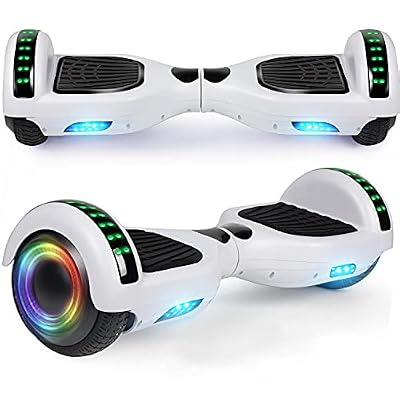
LIEAGLE Hoverboard, 6.5" Self Balancing Scooter Hover Board with Many Certified Wheels LED Lights for Kids Adults(White) Visit the LIEAGLE Store
Included for 'Best Hoverboard Deals: Safe Picks for Kids and Adults' as a relevant option in this category; details come from the product listing.
View on AmazonWeight limit is the spec people ignore
Manufacturers publish a maximum rider weight, and it’s usually generous by 10–15%. Running a board at or above its limit shortens motor and battery life noticeably. Two practical rules:
- A child under about 70 lb will struggle to control a board rated for 220 lb — the self-balancing calibration is tuned for heavier riders and feels twitchy under a light one.
- An adult near or over 200 lb should look for a board rated 250 lb or more, which in practice means 10-inch wheels and a dual-motor design.
Range and charge time
Published range is measured on flat ground at moderate speed with an average-weight rider. Real-world range on pavement with stops, hills, and a heavier rider typically lands 25–35% lower. Charge time is the more honest number: a 2–3 hour charge usually signals a smaller battery with a lower safe continuous discharge rate, while 4–6 hours is typical of a larger pack. Neither is better on its own — a short charge time on a big battery is the combination worth paying for.
Safety certification: the non-negotiable filter
The single most important line on any hoverboard listing is the UL 2272 certification (the electrical system standard for self-balancing scooters). A related standard, UL 2271, covers the battery pack itself; a board carrying both has had its cells, charging circuit, and thermal behavior independently researched. Uncertified boards are the ones that appear in fire reports. If a deal doesn’t state UL 2272, treat it as no deal regardless of price. Helmets matter too: a CPSC-certified bike or skate helmet for every rider, and wrist guards for kids.
Head-to-Head: Three Board Classes Compared
| Class | Wheel size | Weight limit | Typical range | Charge time | Market price |
|---|---|---|---|---|---|
| Kids’ entry board | 6.5 in | 120–165 lb | 6–9 mi | 2–3 hr | $150–$250 |
| Teen / light adult | 8–8.5 in | 200–220 lb | 9–12 mi | 3–4 hr | $220–$350 |
| Adult all-terrain | 10 in | 250–265 lb | 12–18 mi | 4–6 hr | $350–$600 |
Wheel size drives everything downstream. A 6.5-inch wheel catches on a 1-inch lip in pavement and pitches the rider; a 10-inch wheel rolls over it. If your rider will ever be on sidewalks, driveways, or anything that isn’t a smooth indoor floor, the 10-inch class is the safer purchase even though it costs more.
Matching the Board to Your Situation
| Your situation | What to prioritize | What to skip |
|---|---|---|
| Child aged 6–10, first board | 6.5-in wheels, 120–165 lb limit, UL 2272, speed capped in software | Dual motors, 10-in wheels, anything over 10 mph |
| Teen commuting to school (1–2 mi each way) | 8-in wheels, 12 mi range, 3–4 hr charge, puncture-resistant tires | Speaker and LED packages that raise the price |
| Adult 180–220 lb | 10-in wheels, 250 lb+ limit, dual motor, UL 2272 + UL 2271 | Lightweight “travel” boards rated under 200 lb |
| Apartment dweller, indoor use only | 6.5–8-in wheels, quiet motor, compact footprint | All-terrain tread that marks floors |
| Rider with back or balance issues | Wider foot platform, larger wheels for stability | Hoverboards generally — consider a seated scooter instead |
Construction Trade-Offs That Affect Longevity
Two boards at the same price can differ sharply in what they’re made of, and that difference shows up 18 months in, not on day one.
- ABS plastic shell with a metal frame: the common budget build. Light, but the shell cracks at the wheel wells after repeated curb impacts.
- Aluminum alloy frame: stiffer and longer-lived, adds roughly 3–5 lb. Worth it for adults.
- Polycarbonate shell: flexes rather than cracks, better for kids who drop things, but scratches visibly.
- Rubber vs. foam tires: rubber grips wet pavement and lasts years; foam is lighter and never goes flat but wears fast on rough surfaces.
- Battery chemistry: lithium-ion with a named cell manufacturer and a proper BMS. Vague “lithium battery” claims are the most common corner cut on cheap listings.
What Wears Out First — and What That Costs
Owners consistently report the same failure order: tires and inner tubes first (roughly 6–18 months of regular use), then the battery pack’s capacity (18–30 months, dropping to about 60–70% of original range), then the gyroscope/control board. Tire replacement is inexpensive; battery replacement on a cheap board often costs half the purchase price, which is the strongest argument for buying a certified board from a brand with a parts supply in the first place.
Storage matters too. Leaving a hoverboard at full charge in a hot car or garage accelerates battery degradation faster than any riding habit. Store it at around 50–60% charge if it won’t be used for a month or more.
The Real Clearance and Fit Numbers
Hoverboards are small, but they still need space — and this is the part listings never mention.
- A 6.5-inch board occupies roughly 23 × 7 × 7 in and weighs 17–22 lb. It fits a coat closet or under a bed with about 8 in of clearance.
- A 10-inch all-terrain board runs closer to 26 × 10 × 10 in and 26–30 lb — heavy enough that carrying it up more than two flights of stairs gets old fast.
- Doorway clearance is a non-issue, but turning radius indoors isn’t: a board needs about a 3 ft wide path to turn safely, so a hallway narrower than that means carrying it rather than riding it.
- Charging needs a grounded outlet within the cord’s reach (typically 5–6 ft) and, per most manuals, a non-carpeted surface.
How to Spot a Real Deal vs. a Discounted Dud
- Check the certification claim. UL 2272 stated plainly, with a certification file number, is a green flag. “Meets safety standards” with no standard named is not.
- Compare weight limits, not prices. Two boards at $220 with limits of 165 lb and 220 lb are not the same product.
- Look at the charge time. Suspiciously fast charging (under 90 minutes) on an inexpensive board usually means a small pack being pushed hard.
- Confirm parts availability. Tires and batteries you can actually buy later are worth $30–$50 up front.
- Time your purchase. Hoverboard pricing dips in the post-holiday window and again in late spring; the same certified board often swings $40–$80 across the year.
FAQ
Is a cheap hoverboard ever safe?
Yes, if it carries UL 2272 certification. Certification isn’t expensive to obtain, so price alone doesn’t predict safety — but the cheapest listings disproportionately skip it. The floor for a certified kids’ board is around $150.
What weight limit do I need for an adult?
Aim for at least 40–50 lb of headroom above the heaviest rider. A 200 lb adult should buy a board rated 250 lb or more.
How long should a hoverboard last?
With regular use and reasonable storage, expect 2–4 years before the battery needs replacing; tires will need attention well before that.
Can two people ride one hoverboard?
No. Every manufacturer’s limit is a single-rider figure, and doubling the load overheats the motors and control board.
The short version: filter every listing by UL 2272 certification and a weight limit with real headroom, then compare range and charge time against the table above. A board that clears those three checks at $250 is a better deal than an uncertified one at $120 — and it’s one you won’t have to replace in a year.
Related Reviews & Guides


Best Cyber Monday Air Purifier Deals by Room Size
Best Vacuums Black Friday Deals for Every Floor Type