Last Updated: October 4, 2026
For older adults and anyone with limited mobility, a bathroom chair transforms showering from a daily anxiety into something manageable. The core problem is simple: standing on a wet, hard surface for ten minutes is genuinely dangerous when your balance is compromised, and the alternative of sitting on a porcelain tub floor is both uncomfortable and a fall hazard in its own right. The best bathroom chair lets a person bathe independently or with minimal assistance, without the fear of a hip fracture ending their autonomy.
What separates a worthwhile bathroom chair from a disappointing one comes down to a few concrete factors: weight capacity that matches or exceeds the user, adjustable leg height for a proper seated position, stability on wet tile versus tub surfaces, and padding that keeps the experience tolerable for people with joint pain. A $27 stool with non-slip feet and an aluminum frame serves a different buyer than a $45 padded model with armrests designed for someone who cannot sit or stand without support. This roundup, compiled for 2026, compares published specifications and owner-reported experiences across the eight most commonly recommended options.
As an Amazon Associate we earn from qualifying purchases at no extra cost to you.




Quick Picks
| Product | Best for | Price |
|---|---|---|
| HOMLAND Adjustable Height Shower Stool | Budget-conscious buyers with good balance | under $30 |
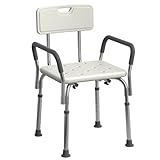
| HOMLAND Shower Chair with Padded Armrests and Back | Maximum comfort at the lowest padded price | under $50 |
| HOMLAND Shower Chair with Removable Back, Aluminum | Lightweight portability and storage | under $40 |
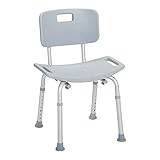
| Drive Medical Premium Shower Chair, White | Trusted medical-grade durability | under $50 |
| Drive Medical Shower Chair with Suction Feet, Gray | Tile floors where suction grip matters | under $40 |
| Dr Kays Shower Bench with 350lb Support | Larger users needing a wide surface | under $30 |
| Bamboo Shower Stool Bench with Storage Shelf | Aesthetics and non-institutional look | under $40 |
| Medline Shower Chair with Padded Armrests | Heavy-duty capacity with full padding | under $50 |
How We Picked
We narrowed these options by evaluating four criteria that consistently appear across owner complaints and product specifications: weight capacity (does the published rating give a safety margin for the intended user?), height adjustability (can the seat be set so the user’s feet rest flat without knee strain?), stability features (suction cups, non-slip rubber feet, or both?), and comfort for extended sitting (padded surfaces versus bare plastic, presence of armrests for leverage during transfers). Products that lack two or more of these were excluded.
The 8 Best Bathroom Chair in 2026
HOMLAND Adjustable Height Shower Stool
This is the entry point for anyone who has a shower stall with a flat floor and needs a stable seat without frills. Owners appreciate the telescoping legs that adjust in small increments, letting users dial in the exact height for their leg length. The non-slip rubber feet grip wet tile adequately, and the plastic seat has drainage slots that prevent pooling.
- Pro: Adjustable leg height across a meaningful range suits multiple users in one household
- Pro: Lowest price in this roundup by a wide margin
- Con: No backrest or armrests — unsuitable for anyone who needs upper-body support to sit down or stand up
Skip this if the user struggles with balance transfers or has arthritis in the hips that makes unassisted standing painful.
HOMLAND Shower Chair with Padded Armrests and Back
The most complete comfort package at a price still under $45. The padded back and armrests make it a realistic option for people recovering from surgery or managing chronic joint pain who need something to lean against. Owners note the armrests pop off for tub-side transfers. The frame is aluminum, keeping the overall weight manageable for caregivers who lift it in and out.
- Pro: Padded surfaces on back and arms reduce pressure on sensitive joints
- Pro: Removable armrests simplify lateral transfers from a wheelchair or tub edge
- Con: Heavier than the basic HOMLAND stool, and the padding can retain moisture if left in a humid bathroom
Skip this if the user is mobile enough for a stool and wants the lightest, least bulky option.
HOMLAND Shower Chair with Removable Back, Aluminum Frame
A middle ground between a stool and a full chair. The backrest detaches cleanly, letting one product serve two configurations. The all-aluminum frame resists rust better than steel alternatives, which matters in a room that stays steamy year-round. Owners highlight how easily it fits into narrower shower stalls where a fixed-back chair would not.
- Pro: Aluminum frame will not corrode and is lighter to lift than steel
- Pro: Removable back lets it convert to a stool when space or preference demands
- Con: No padding on the seat or back, which means less comfort during longer showers
Skip this if pressure relief matters — users with tailbone or sciatic pain will want a padded seat.
Drive Medical Premium Shower Chair, White
Drive Medical has decades of institutional credibility, and this chair reflects that with solid weld points and a finish that resists the yellowing owners report on cheaper white plastic. The padded arms and back are thick enough to stay comfortable through a full rinse cycle. It holds a published 300-pound weight rating that most users will not push.
- Pro: Established medical brand with consistent parts availability and clear published specs
- Pro: Generously padded back and arms feel durable rather than flimsy
- Con: Not height-adjustable — fixed at one seat height that may not suit shorter users
Skip this if the primary user is under five feet two inches; a non-adjustable seat height can leave feet hovering or knees elevated uncomfortably.
Drive Medical Shower Chair with Suction Feet, Gray
The defining feature here is the set of large suction cups on the legs, which adhere to smooth tile and acrylic surfaces far more aggressively than standard rubber feet. Owners on tiled shower floors consistently mention how much the suction eliminates side-to-side sliding during transfers. The seat is plastic with drainage slots and a backrest for basic upper support.
- Pro: Suction feet provide noticeably better grip on smooth wet surfaces than rubber alone
- Pro: Gray finish hides water spots and soap scum better than white alternatives
- Con: Suction cups are less effective on textured or matte-finish tile, limiting where this works
Skip this if your shower floor has a heavy anti-slip texture; the suction cups need a smooth surface to seal.
Dr Kays Shower Bench with 350lb Support
A bench-style design without a back, rated for 350 pounds, which puts it among the highest-capacity options in this group. The wide seat gives larger users room to shift position, and the frame is aluminum with rubber-tipped feet. Owners who find narrow plastic seats uncomfortable specifically call out the bench width as the reason they chose this over traditional chairs.
- Pro: 350-pound weight rating and wide seat accommodate larger users comfortably
- Pro: Bench-style profile has no back to get in the way of caregiver access
- Con: No backrest means zero upper-body support for anyone who cannot maintain trunk stability unaided
Skip this if the user cannot sit upright independently or needs back support during bathing.
Bamboo Shower Stool Bench with Storage Shelf
Aimed at buyers who want a bathroom chair that does not look like medical equipment. The bamboo construction and integrated lower shelf for bottles make it functional without the institutional appearance. Owners in rental properties and shared bathrooms like that it blends with standard bathroom d\u00e9cor. The bamboo is treated for moisture resistance, though it still requires more care than plastic or aluminum.
- Pro: Attractive finish that removes the stigma some users feel about medical-looking furniture
- Pro: Built-in storage shelf keeps shampoo and soap within reach
- Con: Bamboo demands periodic re-sealing and is less forgiving of prolonged standing water than synthetic materials
Skip this if the shower is used daily without a chance for the stool to dry fully between uses.
Medline Shower Chair with Padded Armrests and Back
Combines Medline’s heavy-duty construction (350-pound capacity) with the comfort of padded surfaces and height adjustability — a rare all-in-one. Owners note the legs adjust across five positions, and the padding is thick and sealed so it does not absorb water the way open-cell foam would. It is the most feature-complete option in this roundup.
- Pro: 350-pound capacity paired with adjustable height covers a wide range of users
- Pro: Sealed padding resists moisture absorption and wipes clean easily
- Con: Highest price in the group and heaviest, making it less practical for travel or frequent relocation
Skip this if the user is slim, short, and does not need the upper weight rating — you are paying for capacity you will not use.
Buying Guide
Weight Capacity and How to Read It
Published weight ratings are maximum limits, not comfortable working limits. A 300-pound rated chair is safe for a 250-pound user but may feel less stable under repeated loading if the joints are marginal. Look for chairs rated at least 50 pounds above the primary user’s weight. The Dr Kays bench and Medline chair both publish 350-pound ratings, which gives a meaningful safety margin for a wider audience.
Height Adjustability Versus Fixed Height
A bathroom chair that cannot adjust its seat height is a one-size-fits-none product. The ideal seat places the user’s thighs roughly parallel to the floor with both feet flat, knees at about 90 degrees. Telescoping legs with multiple holes or a locking mechanism give that range. The HOMLAND adjustable stool and Medline chair offer this; the Drive Medical Premium does not. For households where more than one person uses the chair, adjustability is not optional.
Stability Features: Feet, Suction, and Surface Type
Rubber feet work on textured tile and tub floors. Suction cups outperform rubber on smooth acrylic or glossy ceramic but fail on matte or heavily textured surfaces. A chair with both rubber tips and suction offers the most flexibility. The Drive Medical suction-foot model is specifically engineered for this distinction, and it is worth confirming your shower floor type before purchasing any option in this category.
Our Verdict
The Medline Shower Chair with Padded Armrests is our top pick overall: it is the only option that combines 350-pound capacity, adjustable height, sealed padding, and armrests in a single product, making it the least compromise-laden choice for most buyers.
Our budget pick is the HOMLAND Adjustable Height Shower Stool for under $30. It will not serve everyone, but for a mobile user who needs a stable seat without back support, it covers the basics at the lowest price with no meaningful quality complaints in owner feedback.
If the primary bathroom surface is smooth tile or acrylic and the user reports any sliding during transfers, the Drive Medical Suction Feet model for under $40 wins over both of the above despite its lower price, because the grip difference is the single most consequential feature in that scenario.
FAQ
Can a bathroom chair be used in a bathtub with a raised edge?
Only if the user can safely step over the tub wall to place the chair inside, or if the chair is positioned on a bench that extends beyond the rim. Most people with mobility limitations use these chairs in walk-in showers or on tub benches. For tubs with high sides, pair the chair with a grab bar at the entry point.
How do I prevent a bathroom chair from sliding during use?
Match the foot type to your floor material. Smooth surfaces need suction cups; textured surfaces need rubber tips that can bite into the grain. Press firmly on each foot before use to ensure full contact, and replace rubber feet once they show hardening or flattening.
Is a padded seat better than plastic for a bathroom chair?
Padded seats reduce pressure on the tailbone and hips, which matters for anyone with arthritis or who showers seated for longer than a few minutes. The trade-off is that padding must be sealed against water absorption. Unsealed foam padding degrades quickly in a steamy bathroom, so look for products that specify moisture-resistant or wipeable padding.
How often should a bathroom chair be replaced?
There is no fixed interval, but inspect the legs, joints, and feet every few months. Plastic can develop stress cracks, rubber feet lose grip as they dry out, and aluminum frames are generally the longest-lasting. Replace the chair when any structural element feels loose or the feet no longer hold position on a clean, dry surface.
Related Reviews & Guides



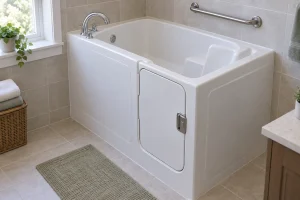
Best Walk in Tubs for Seniors in 2026: Compared and Ranked

Best Glucose Monitor Without Finger Pricks