Last Updated: November 23, 2026
As an Amazon Associate I earn from qualifying purchases.
The Short Answer
The best hydraulic patient lifts for adult assisted living spaces use a manual hydraulic pump to raise a person in a sling, with no battery to charge and no motor to maintain. That simplicity is the main reason care teams keep choosing them. A hydraulic lift works during a power cut, it has fewer parts that can fail, and a caregiver can learn to use it in one training session.
For most assisted living spaces, the Invacare 9805P is the strongest starting point. It lists a 450-pound capacity, a bent mast that keeps the person clear of the frame, and a base that spreads from 22 to 62 inches to fit around beds and chairs. If the sling should arrive with the lift, the Invacare 9805P bundled with a large mesh sling is the simpler purchase. The Vive Hydraulic Patient Lift is the compact pick, with a 400-pound capacity and a low-profile base that slides under low furniture. Before choosing, check the user’s weight, the sling size, the doorway widths, and whether the caregiver can work the pump comfortably. A hydraulic lift also costs less to maintain than a powered lift, since there is no battery to replace and no motor to service.
Our Top Picks

- Invacare Hydraulic Patient Lift 9805P — Best for general assisted living use. 450-pound capacity, bent mast, 6-point padded swivel bar. Check on Amazon
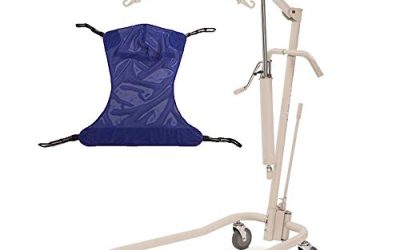
- Invacare 9805P with Large Mesh Sling — Best for a bundled sling purchase. Same 450-pound lift with a large mesh sling included. Check on Amazon
- Vive Hydraulic Patient Lift — Best for compact spaces and simple manual use. 400-pound capacity, low-profile base, adjustable width. Check on Amazon
Quick Comparison
| Product | Best for | Key spec | What to check |
|---|---|---|---|
| Invacare 9805P | General assisted living use | 450 lb capacity, lift range 20 to 64 inches | Base width range and sling fit |
| Invacare 9805P with Sling | Bundled sling purchase | 450 lb capacity, large mesh sling included | Sling size for the user |
| Vive Hydraulic | Compact spaces, simple use | 400 lb capacity, low-profile base | Base height and doorway fit |
How to Choose
Weight capacity with a margin. Allow at least 20 pounds above the user’s weight. The Invacare 9805P lists 450 pounds, which covers most adults, while the Vive lists 400 pounds and suits lighter users.
Lift range. The lift must raise the person high enough to clear the bed or chair and lower them fully onto the next seat. The Invacare 9805P lists a lift range of 20 to 64 inches, which covers floor recovery as well as bed-to-chair moves.
Base width and base height. A wide base fits around beds and wheelchairs; a low base slides under low furniture. The Invacare base spreads from 22 to 62 inches. The Vive has a low-profile base, so confirm the base height on the listing.
Sling compatibility. A hydraulic lift is only as good as its sling. Check that the sling matches the user’s body size and that it attaches to the lift’s spreader bar. The Invacare bundle includes a large mesh sling; the Vive lift needs a compatible sling chosen separately.
Pump effort. The caregiver works the hydraulic pump by hand, so the handle should move smoothly through its full range. A lift that is hard to pump will not get used. Confirm the pump style on the listing.
Mast and spreader bar design. A bent mast keeps the person away from the frame during the lift. A padded swivel bar with several attachment points, like the 6-point bar on the Invacare 9805P, spreads the sling load evenly.
Storage and maneuvering. A lift that folds or stores upright takes less room between uses. Check the folded dimensions and the caster size, since larger casters roll more easily over thresholds and carpet.
The Picks in Detail
Invacare Hydraulic Patient Lift 9805P
The Invacare 9805P is a manual hydraulic patient lift with a listed weight capacity of 450 pounds and a lift range of 20 to 64 inches. Its bent mast keeps the person clear of the frame, and the 6-point padded swivel bar spreads the sling load evenly. The base adjusts from 22 to 62 inches wide, so it fits around beds, chairs, and wheelchairs. It suits assisted living spaces that need one dependable lift for bed-to-chair moves and floor recovery. Confirm the sling size and the exact parts included on the listing.
Pros:
– 450-pound capacity with a wide lift range
– Bent mast and padded swivel bar for safer lifts
– Wide adjustable base fits around furniture
Cons:
– Sling sold separately in this listing
– Manual pumping takes caregiver effort
Best for: Assisted living spaces that need one dependable hydraulic lift.
What to check: Sling size, base width range, and the exact parts included.
Invacare 9805P with Large Mesh Sling
This is the same Invacare 9805P hydraulic lift, bundled with a large mesh sling, so the care team can start transferring without a separate sling purchase. The lift lists a 450-pound capacity, a lift range of 20 to 64 inches, and the same bent mast and 6-point padded swivel bar as the base model. The mesh sling suits bathing and toileting transfers as well as bed-to-chair moves, since mesh dries faster than solid fabric. Confirm that the large sling size fits the user, since a sling that is too large can let the person slide.
Pros:
– Same 450-pound lift with the sling included
– Mesh sling suits bathing and toileting transfers
– One purchase covers lift and sling
Cons:
– Large sling may not fit smaller users; confirm the size
– Manual pumping takes caregiver effort
Best for: Care teams that want the lift and sling in one purchase.
What to check: Sling size against the user’s measurements.
Vive Hydraulic Patient Lift
The Vive Hydraulic Patient Lift is a manual hydraulic lift with a listed weight capacity of 400 pounds and a low-profile base that slides under low furniture. Its base adjusts in width, and the compact frame suits smaller rooms and tight corners where a larger lift would struggle. It is a good fit for home care and smaller assisted living rooms that need simple, dependable manual lifting without a battery or motor. Confirm the base height, base width range, and sling compatibility on the listing before ordering.
Pros:
– 400-pound capacity in a compact frame
– Low-profile base fits under low furniture
– Simple manual operation with no battery
Cons:
– Lower capacity than the Invacare 9805P
– Sling chosen separately; confirm compatibility
Best for: Smaller rooms and home care where space is tight.
What to check: Base height, base width range, and sling compatibility.
Who Should Choose What
| Situation | Best pick |
|---|---|
| One dependable lift for general assisted living use | Invacare 9805P |
| Lift and sling in a single purchase | Invacare 9805P with Large Mesh Sling |
| Small room or tight corners | Vive Hydraulic Patient Lift |
| Floor recovery after a fall | Invacare 9805P |
| Bathing and toileting transfers | Invacare 9805P with Large Mesh Sling |
| User above 400 pounds | Invacare 9805P |
Common Mistakes
- Choosing a lift without checking the sling. The lift and the sling work as a pair. A sling that does not fit the user or the spreader bar is unsafe, no matter how strong the lift is.
- Ignoring the base height. A base that cannot slide under the bed cannot get close enough for a safe transfer. Check the base height against the bed frame.
- Forgetting the lift range. A lift that cannot rise high enough will not clear the chair or the bed. Confirm the lift range covers your tallest transfer point.
- Skipping caregiver training. A hydraulic lift is simple, but the pump, the brakes, and the sling attachment all need practice. Train every caregiver before the first real transfer.
- Storing the lift where it blocks a path. A lift left in a hallway becomes a trip hazard. Plan a storage spot that keeps it out of walking routes.
- Using a worn sling. Check slings for fraying, torn stitching, and worn straps before every use, and replace any sling that shows damage.
Frequently Asked Questions
How does a hydraulic patient lift work?
The caregiver pumps a hydraulic handle to raise the person in a sling, then opens a valve to lower them gently. No battery or motor is involved, so the lift works during a power cut.
Who is a hydraulic lift for?
It is for an adult who cannot bear their own weight and needs full support during transfers between a bed, a chair, a wheelchair, or the floor, with a caregiver operating the lift. It also suits floor recovery after a fall, since the lift range reaches low enough to pick a person up from the floor.
What weight capacity should I choose?
Allow at least 20 pounds above the user’s weight. The Invacare 9805P lists 450 pounds, and the Vive lists 400 pounds. Pick the one that covers the user with a margin.
Does the Invacare 9805P include a sling?
The base listing does not include a sling. The bundled listing with the large mesh sling includes one. Confirm the included parts on the exact listing you order.
Can a hydraulic lift pick someone up from the floor?
The Invacare 9805P lists a lift range starting at 20 inches, which supports floor recovery in many cases. Check the range against your situation and confirm the details on the listing.
What should I confirm on the listing before ordering?
Confirm the weight capacity, lift range, base width and height, sling size and compatibility, and the exact parts included. Measure the bed, the chair, and the doorways first.
Conclusion
The best hydraulic patient lifts for adult assisted living spaces are simple, strong, and matched to the room. The Invacare 9805P is the dependable all-around pick, the bundled version adds the sling in one purchase, and the Vive suits smaller spaces. Check the weight capacity, the sling fit, and the base dimensions, then choose the lift that makes every transfer steady and safe.
Related Reviews & Guides



Bed Assist Rail Handle Senior Review
6 Best Batteries For A Mobility Scooter 2026