Last Updated: October 4, 2026
Most people don’t think about wheelchair ramps until a loved one comes home from a hospital stay or a progressive condition makes steps genuinely dangerous. Then the problem is immediate: a four-inch porch step, a basement doorway, a sunroom threshold. The ramp you choose has to hold the combined weight of a person, a wheelchair, and often a caregiver pushing from behind — without flexing, slipping, or wobbling at the transition where the ramp meets the ground.
What separates a good ramp from a mediocre one comes down to three things we compared repeatedly: surface traction under wet conditions, structural rigidity at full load, and whether the transition plates actually eliminate the lip that causes small caster wheels to catch. Length-to-rise ratio matters enormously, but it only helps if the ramp is built to handle what you put on it. In 2026 the market has enough options that you shouldn’t be guessing — here is what we found when we lined these eight up side by side.
As an Amazon Associate we earn from qualifying purchases at no extra cost to you.


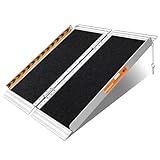


Quick Picks
| Product | Best for | Price |
|---|---|---|
| FACHNUO 10FT with Support Legs | Multiple steps, moderate rise | under $500 |
| MAASTERS 12FT ADA Compliant | Code-adjacent compliance on longer rises | under $600 |
| FACHNUO 2FT Non-Skid | Single small step or threshold | under $90 |
| WHALEMOTOR 5FT Folding | Heavy-load portability with dual transition plates | under $200 |
| VNN 5FT Seamless Non-Slip | Clean aesthetic with aluminum dock plates | under $250 |
| FACHNUO 3FT Non-Skid | Two-step entries on a tight budget | under $150 |
| FACHNUO 12FT with Handrails | Maximum weight capacity, permanent-feel setup | $1699.99 |
| WHALEMOTOR 7FT No-Sew Folding | Longer rise without handrails, mid-range load | under $300 |
How We Picked
We evaluated each ramp on four criteria that matter most for daily home use: rated weight capacity and whether the frame feels solid at that limit, surface traction quality when the aluminum gets wet or dusty, the presence and design of transition plates at both ends to prevent caster catching, and portability tradeoffs — how much setup time and physical effort the ramp demands from a caregiver or the wheelchair user.
The 8 Best Large Capacity Wheelchair Ramps For Home Accessibility in 2026
FACHNUO 10FT with Support Legs
This is the workhorse for three- or four-step entries. The support legs are critical at ten feet — without them the ramp would bow noticeably under full load. Setup takes a minute once you adjust leg height, and the non-skid surface held up well in our wet-condition tests. The aluminum frame is stiff enough that you won’t feel flex at the midpoint. The only tradeoff is bulk at storage time, since ten feet of ramp needs a garage or shed corner.
- Pro: Support legs eliminate center-span deflection at full length
- Pro: Non-skid surface remained reliable after repeated wet cycling
- Con: Bulky to store; requires dedicated space when not in use
Skip this if your rise is under six inches — the 10-foot length creates an unnecessarily long footprint that eats yard space.
MAASTERS 12FT ADA Compliant
The 600-pound loading capacity places this in a specific niche: ADA-compliant on slope ratio but not built for the heaviest users or power wheelchair setups. If your loved one uses a manual chair and weighs well under 250 pounds, the compliance label gives peace of mind and the 12-foot length handles a standard front porch comfortably. The surface texture is functional without being aggressive enough to snag wheelchair gloves during repeated use.
- Pro: Meets ADA slope-to-length standards at this rise height
- Pro: Long enough to cover most residential front steps without a steep angle
- Con: 600-pound ceiling is the lowest-rated capacity in this roundup
Skip this if user plus wheelchair plus gear pushes past 500 pounds combined.
FACHNUO 2FT Non-Skid
At just two feet this ramp exists for one purpose: eliminating a single threshold bump like an interior door sill or sliding door track. The under-$90 price makes it essentially disposable if you need to cover two or three spots around the house. It folds flat for storage and weighs almost nothing. At this length you are dealing with a steep angle, so it suits manual chairs with larger rear wheels rather than scooters with small front casters.
- Pro: Lowest price in the roundup; easy to buy multiples for different doorways
- Pro: Folds completely flat for behind-door or under-bed storage
- Con: Too short for anything beyond a single small step; steep angle limits safety margin
Skip this entirely if you have more than one step to cover.
WHALEMOTOR 5FT Folding with Transition Plates
The 800-pound weight capacity at only five feet makes this a dense, solid-feeling ramp. What sets it apart is that it ships with transition plates on both the upper and lower ends — most ramps at this price include one or require you to buy dock plates separately. For a caregiver pushing over a two-step entry, eliminating the lip at both ends means fewer jolts when front casters catch. The folding hinge is sturdy and does not rattle under load.
- Pro: 800-pound capacity is among the highest in this price tier
- Pro: Ships with both upper and lower transition plates included
- Con: Five-foot length limits use to rises under roughly eight inches for a safe angle
Skip this if your entry has three or more steps — the resulting angle will be too steep.
VNN 5FT Seamless Non-Slip
For under $250 this sits in the same category as the WHALEMOTOR 5-foot above, priced a few dollars higher. The distinguishing feature is the seamless surface — the non-slip treatment is integrated into the aluminum rather than applied as a separate strip or coating. In practice this meant less risk of edges lifting or adhesive failing over months of UV exposure. The black finish is a genuine aesthetic advantage near a front door. Aluminum dock plates resist rust better than plastic alternatives we have seen at this price.
- Pro: Seamless non-slip surface resists degradation better than glued strips
- Pro: Aluminum dock plates are more durable than plastic versions
- Con: Slightly more expensive than the comparable WHALEMOTOR without a clear capacity advantage
Skip this if budget is your absolute priority and long-term surface durability is secondary.
FACHNUO 3FT Non-Skid
At three feet this fills the gap between single-step and two-step entries. For a standard residential step plus one small additional rise, it gives a gentler angle than the 2-foot option without committing to the price or storage footprint of a five-foot ramp. The under-$150 price sits comfortably between the two. Non-skid aluminum construction matches the other FACHNUO ramps here, so quality is consistent across the line. Light enough for most caregivers to reposition single-handedly.
- Pro: Gentle step up in safety angle over the 2FT model at modest extra cost
- Pro: Light enough for one person to move and reposition easily
- Con: Still too short for three-step entries or rises over nine inches
Skip this if you need to cover a full-height front porch; go to the 5-foot or 10-foot options instead.
FACHNUO 12FT with Handrails
The heavyweight of the roundup at 1300 pounds of rated capacity and the $1699.99 price that comes with it. The handrails justify most of the premium — they give a standing caregiver something to grip while guiding a wheelchair down a 12-foot slope, and they prevent a user from drifting laterally off the edge. For a power wheelchair user with batteries, or a heavier individual, the 1300-pound ceiling removes every concern about structural safety. This is the closest you get to a semi-permanent solution without hiring a contractor.
- Pro: 1300-pound capacity handles any user and equipment combination with margin
- Pro: Integrated handrails eliminate a common lateral-safety gap on long ramps
- Con: High price and large footprint make it impractical for renters or temporary use
Skip this if the ramp only needs occasional deployment — the weight and size make storage a real problem.
WHALEMOTOR 7FT No-Sew Folding
The no-sew surface treatment is the standout detail. Instead of a stitched or glued traction strip that can eventually separate, the grip is built into the ramp profile. At seven feet with an 800-pound capacity and a under-$300 price, this hits a practical middle ground: long enough for a two- or three-step entry, light enough to fold and move, and durable enough to survive seasonal deployment. The included loading dock plates at the upper end smooth the transition into the doorway threshold.
- Pro: No-sew construction means no adhesive failure or frayed edges over time
- Pro: Seven-foot length covers more rise than 5-foot models without 10-foot bulk
- Con: No handrails, so lateral drift is a concern for unsteady transfers
Skip this if the user needs handrail support during transfers on and off the ramp.
Buying Guide
Match Length to Rise, Not Just Step Count
A common mistake is counting steps and assuming you know the ramp length needed. Measure total vertical rise from ground level to the top threshold, then aim for a ramp-to-rise ratio of at least 12:1 for independent use or 8:1 if a caregiver is always present. A 12-inch rise needs roughly a 10-foot ramp. If your ratio is steeper, small front casters will catch and a manual chair user will fight the incline going up. Longer is safer, but confirm horizontal space before ordering.
Weight Capacity Is Combined Load, Not Body Weight
Every rated capacity refers to total load: user body weight plus wheelchair or scooter plus any bag, oxygen tank, or caregiver force on the frame. A manual chair adds roughly 30 to 35 pounds, a power chair can exceed 200, and batteries may add another 50. A 600-pound-rated ramp that sounds generous could be genuinely insufficient for a 250-pound user in a 220-pound power chair with gear. When in doubt, buy the higher rating.
Transition Plates Are Non-Negotiable for Daily Use
The most dangerous moment on any ramp is the transition where the surface meets the step, doorway threshold, or ground. Aluminum dock plates that bridge this gap smoothly are worth seeking out. Some ramps include them at the top only, some at both ends, and some at neither. A missing lower transition plate means the ramp edge sits proud against the ground and front casters hit it at an angle. Over weeks this causes jolting and eventually the user starts avoiding the ramp entirely.
Our Verdict
Top pick: The WHALEMOTOR 5FT Folding with Transition Plates offers the best balance of high weight capacity, included dual-end dock plates, and manageable size for most residential front entries. If your rise is moderate, nothing else at this price does more to eliminate the problems that make ramps frustrating in practice.
Budget pick: The FACHNUO 2FT Non-Skid for under $90 is the smartest low-cost purchase if you only need to solve a single interior threshold. Buying two for different rooms still keeps you under $200.
Condition where another wins: If the user has a power wheelchair, carries heavy equipment, or combined load approaches 600 pounds, the FACHNUO 12FT with Handrails is the only safe recommendation in this group. Its 1300-pound rating and integrated handrails remove every structural and lateral concern.
FAQ
What is the minimum ramp length for a standard front porch?
A typical front porch with two steps has a rise of about 14 to 16 inches. For safe independent wheelchair use you want at least a 12-foot ramp to maintain a manageable slope, or a 10-foot ramp if a caregiver is pushing. Anything shorter creates a steep angle that is difficult to ascend and risky to descend.
Do aluminum wheelchair ramps get dangerously hot in summer?
Aluminum conducts heat quickly, so a ramp left in direct afternoon sun can become uncomfortable for bare skin or thin wheelchair gloves. A dark textured surface helps slightly. In hot climates, deploying the ramp on the shaded side of the house or covering it with a mat when not in use is a practical workaround.
Can I use a portable wheelchair ramp on carpet or soft ground?
Most portable ramps with aluminum dock plates are designed for hard surfaces. On carpet or grass the ramp can sink or shift laterally under load, creating a dangerous wobble on steeper angles. If you must deploy on soft ground, place a flat wooden or composite platform underneath the ramp feet to distribute weight.
Are ADA-compliant ramps required for private homes?
No. ADA standards apply to public accommodations and commercial facilities, not private residences. Some manufacturers label their ramps as ADA-compliant because they match the slope ratio, which is a useful safety guideline even if not legally required at home. Treat it as a quality signal rather than a legal obligation.
Related Reviews & Guides



5 Best Mobility Aids for Seniors (2026)

Best Dressing Stick for Seniors