Last Updated: September 27, 2026
Grab bars are one of the simplest, most effective ways to reduce fall risk in a parent’s home, particularly in the bathroom where wet surfaces, standing up, and sitting down combine. Yet many grab bars are installed in the wrong spot, at the wrong height, or with anchors that cannot hold a real fall. Towel bars and suction cups are sometimes mistaken for safety bars. This guide explains which grab bars to buy, where to put them, and how to make sure they will hold when it counts.
Where Your Parent Needs Grab Bars
Shower and tub
A vertical bar at the entry helps with stepping in and out. A horizontal or angled bar on the back or side wall helps with balance while washing. A bar near a shower seat helps with sitting and standing.

Moen Home Care Bathroom Safety 24 Inch Stainless Steel Handicap Grab Bar for Bathtub and Shower, Heavy Duty Handle, Elderly Assistance Product with Concealed Screws, 8724
Included for 'How to choose the best grab bars for elderly parents' because the listing specifies Heavy Duty Handle and Elderly Assistance Product with Concealed Screws, details this guide uses to compare options.
View on Amazon
Moen Brushed Nickel Bathroom Safety 12-Inch Designer Bathroom Grab Bar with Curled Grip, Shower Handles for Elderly, R8712D3GBN
Included for 'How to choose the best grab bars for elderly parents' because the listing specifies Shower Handles for Elderly and R8712D3GBN, details this guide uses to compare options.
View on Amazon
Moen Home Care Bathroom Safety 16 Inch Handicap Grab Bar for Bathtub and Shower with Storage Shelf, Elderly Assistance Product, Brushed Nickel, R2356DBN
Included for 'How to choose the best grab bars for elderly parents' because the listing specifies Elderly Assistance Product and Brushed Nickel, details this guide uses to compare options.
View on Amazon
Moen Home Care Bathroom Safety 36 Inch Stainless Steel Handicap Grab Bar for Bathtub and Shower, Peened Texture for Grip, Elderly Assistance Product with Concealed Screws, R8936P
Included for 'How to choose the best grab bars for elderly parents' because the listing specifies Peened Texture for Grip and Elderly Assistance Product with Concealed Screws, details this guide uses to compare options.
View on AmazonToilet
A horizontal bar on the side wall next to the toilet gives leverage for sitting and standing. If there is no wall, a floor-mounted or toilet-mounted safety frame can substitute.
Other areas
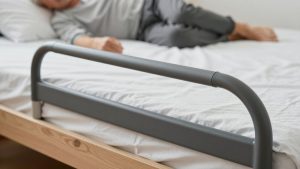
Bars can also help at the bottom of stairs, near the bed, or at entry steps. Assess where your parent reaches for support now, such as sinks, towel bars, or furniture, and put proper bars there.
Choosing the Right Bar
| Feature | Common options | What to choose |
|---|---|---|
| Length | 12, 16, 18, 24, 32, 36, 42 in | Long enough to span studs and reach |
| Diameter | 1.25-1.5 in | Comfortable full grip for your parent’s hand |
| Surface | Smooth, knurled, textured | Textured for wet hands |
| Weight rating | Often 250-500 lb | Installed correctly into studs or rated anchors |
| Style | Straight, angled, L-shaped, flip-up | Match the task and space |
Suction cup bars are not grab bars
Suction bars can loosen without warning and are generally designed only for light balance assistance, not for bearing weight. Do not rely on them to stop a fall.
Placement Guidelines
Common accessibility guidance places horizontal grab bars around 33 to 36 inches above the floor. Vertical bars at shower entries are often placed so the bottom starts around 36 to 40 inches high, extending upward to suit your parent’s height. Ultimately, the best location is where your parent naturally reaches. Have them mime the motion of getting in and out of the shower or onto the toilet before marking the spot.
Installation That Holds
Anchor into studs when possible
Studs are usually spaced 16 inches apart. Longer bars, such as 24 or 32 inches, make it easier to hit two studs. Where studs are not available, specialized grab bar anchors rated for the load can be used, but follow the manufacturer’s instructions exactly.
Tile and fiberglass
Drilling through tile requires the right bit and care to avoid cracking. Fiberglass surrounds often need special anchors or backing. If you are not confident, hire a handyman or contractor; professional installation often costs around $100 to $300 per bar depending on wall type and region.
Style and Acceptance
Some parents resist grab bars because they look institutional. Many modern bars come in finishes that match bathroom fixtures, and some double as towel holders or shelves while still being weight-rated. Choosing an attractive design can make acceptance easier.
A Quick Room-by-Room Checklist
Walk through the home with your parent and watch where they steady themselves. In the bathroom, note the shower entry, the back wall of the tub, and the side of the toilet. In the bedroom, look at the side of the bed they use to get up at night. At entry doors, check the steps where they carry groceries. Near stairs, confirm a sturdy handrail runs the full length on at least one side, ideally both. Each of those touchpoints is a candidate for a properly anchored bar, and addressing the two or three most-used spots first usually gives the biggest safety gain.
FAQ
Can I use a towel bar as a grab bar?
No. Towel bars are not designed to hold body weight and can pull out of the wall. Replace them with weight-rated grab bars or combination bars built for support.
How many grab bars does a bathroom need?
Most bathrooms benefit from at least two: one at the shower or tub and one near the toilet. Many families add a third where their parent tends to steady themselves.
Bottom Line
The best grab bars for your parent are weight-rated, textured, the right diameter for their grip, and installed securely where they naturally reach. Skip suction cups and towel bars for support, hit studs or use rated anchors, and consider a professional installer for tile. A few well-placed bars can prevent some of the most common falls at home.
Related Reviews & Guides


5 Best Compression Socks Mens (2026)

Best Home Health Monitoring Kit for Aging Parents