Last Updated: September 27, 2026
When a parent starts holding onto furniture to cross a room or stopping to rest on every errand, a rollator often comes up as the next step. Rollators have wheels, hand brakes, and a built-in seat, so they can make walking feel freer and less tiring than a standard walker. But the wrong rollator can roll away at the worst moment, sit at the wrong height, or be too heavy to lift into the car. This guide explains how to choose one that matches your parent’s body, home, and habits.
First, Is a Rollator the Right Device?
Rollators suit people who need support for balance and endurance but can walk at a fairly steady pace and operate hand brakes. They are generally not the best choice for someone who leans heavily on the device for weight bearing, has significant cognitive impairment, or cannot squeeze brake levers. For those people, a standard or two-wheeled walker is often safer. A physical therapist evaluation before buying is worth the time.

Drive Medical Rollator Walker with Seat, 7.5 Inch Wheels, Blue
Included for 'How to choose the best rollator walker for elderly parents' because the listing specifies 7.5 Inch Wheels and Blue, details this guide uses to compare options.
View on Amazon
Drive Medical Nitro Sprint Rollator Walker with Seat, Standard Size, Red
Included for 'How to choose the best rollator walker for elderly parents' because the listing specifies Standard Size and Red, details this guide uses to compare options.
View on Amazon
VOCIC Z21 Rollator Walker for Seniors with Seat, 8" All Terrain, 350 LBS
Included for 'How to choose the best rollator walker for elderly parents' because the listing specifies 8" All Terrain and 350 LBS, details this guide uses to compare options.
View on Amazon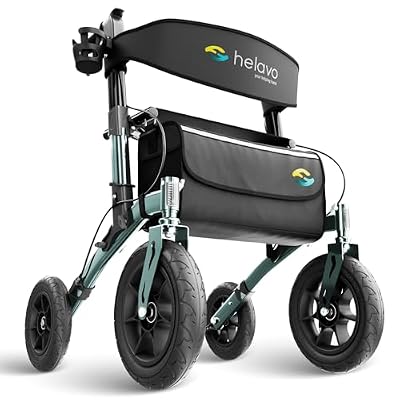
Helavo All Terrain Walker, 12" Pneumatic Tires, Outdoor Rollator Walker
Included for 'How to choose the best rollator walker for elderly parents' because the listing specifies 12" Pneumatic Tires and Outdoor Rollator Walker, details this guide uses to compare options.
View on AmazonThree-Wheel vs. Four-Wheel
Three-wheel rollators are narrow and turn tightly, which helps in small apartments, but they have no seat and are less stable. Four-wheel rollators are more stable, include a seat, and are the most common choice for seniors who need rest breaks.
Key Measurements
| Measurement | How to check | Typical range |
|---|---|---|
| Handle height | Wrist crease with arms relaxed | 31-39 in adjustable |
| Seat height | Knees at 90 degrees, feet flat | 18-23 in (lower for petite users) |
| Seat width | Hip width plus a little room | 13-18 in |
| Frame weight | Can the caregiver lift it? | 11-22 lb |
| Weight capacity | User weight plus margin | 250-500 lb |
| Wheel diameter | Indoor vs outdoor use | 6-10 in |
Match the Rollator to Your Parent
Height and body size
A handle set too high pushes shoulders up and reduces control; too low causes stooping. Petite parents under about 5 feet 3 inches often need a model with a lower seat height so their feet reach the floor when they sit. Tall parents need a frame that adjusts high enough without maxing out.
Where they will use it
Mostly indoors in a small home? Smaller 6- to 7-inch wheels and a narrow frame, around 22 to 24 inches wide, are easier to maneuver through doorways. Outdoors on sidewalks and parking lots? Larger 8- to 10-inch wheels roll over cracks and curb cuts more smoothly.
Hand strength and brakes
Standard loop brakes require squeezing to slow and pushing down to lock. If your parent has arthritis or weak grip, look for easy-squeeze brakes or a push-down braking style. Before every trip, the brakes should be locked whenever your parent sits on the seat.
Transport and storage
If you drive your parent to appointments, lift the rollator yourself before buying. A 20-pound steel model can become a daily burden, while a 13-pound aluminum model is much easier. Check that it folds narrow enough for your trunk and closet.
Features That Add Real Value
A padded backrest makes the seat usable for longer rests. A basket or bag under the seat keeps hands free. Cane holders and cup holders are small conveniences. Reflectors or lights help with evening walks. Skip extras that add weight without addressing a real need.
Insurance and Where to Buy
Medicare Part B may cover a rollator as durable medical equipment when a clinician prescribes it and a Medicare-enrolled supplier provides it; your parent may owe coinsurance after the deductible. Buying from a local medical supply store lets you try heights and brakes in person, which is valuable for a first rollator.
Teaching Safe Use
Show your parent how to walk inside the frame rather than pushing it far ahead, how to lock both brakes before sitting, and never to ride on the seat while someone pushes. Remove throw rugs and clear paths at home. Check tires, brakes, and bolts every month.
FAQ
Can a rollator replace a cane?
It offers more support than a cane, so it is often the next step when a cane no longer feels secure. Some parents use a cane indoors and a rollator for outings.
How do I know if the brakes need adjusting?
If the rollator still rolls when the brakes are locked, or your parent must squeeze very hard to slow down, the cables need tightening. Many supply stores will adjust them for free.
Bottom Line
The best rollator for your parent is the one that fits their height, suits their home and outings, and has brakes they can actually operate. Measure handle and seat heights, weigh the frame against who will lift it, and involve a physical therapist if you are unsure. A well-fitted rollator can restore both confidence and independence.
Related Reviews & Guides



Best Cane for Arthritis

6 Best Large Button Cell Phones For Seniors 2026