Last Updated: October 4, 2026
Choosing between an upright walker and a rollator walker isn’t really about which device is “better.” It’s about posture, confidence, and the layout of your home. A rollator — the familiar four-wheeled walker with a seat between the handlebars — asks you to lean slightly forward as you push it. An upright walker repositions the handles so you stand taller, which many people with back pain, stooped posture, or shoulder issues find dramatically more comfortable. But upright walkers cost more, weigh more, and take up more room. Here’s how the two compare in 2026, with real numbers to help you decide.
Quick Verdict
Buy a rollator if: budget matters, you want the lightest and most compact option, or you mainly need a seat for outdoor outings and errands. Solid basic models start around $53, and most fold down small enough for a car trunk or apartment closet.
As an Amazon Associate we earn from qualifying purchases at no extra cost to you.

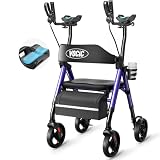


Buy an upright walker if: you hunch over your current walker, you have chronic back or neck pain, or you’ve noticed your posture worsening. Expect to spend $150–$400 for a quality model, but the standing posture can reduce fatigue enough that you actually walk more.
For most first-time buyers on a budget, a rollator is the practical starting point. For anyone whose main complaint is pain from leaning forward, the upright design is worth the premium.
Side by Side
| Feature | Upright Walker | Rollator Walker |
|---|---|---|
| Posture | Handles positioned in front, arms stay straight; promotes upright stance | Handles under shoulders; most users lean forward slightly |
| Comfort for back pain | Excellent — reduces neck and upper-back strain | Fair to good, depending on handle height and fit |
| Typical price range | $150–$400 | $50–$200 |
| Typical weight | 20–28 lbs | 14–19 lbs |
| Seat comfort | Often a wider padded sling or firm seat | Padded seat standard; some models include a backrest |
| Folded size | Bulkier; often 30–40″ long folded | More compact; many fold to roughly 24–28″ wide |
| Wheels | Usually 8–10″ wheels, often solid rubber tires (puncture-proof) | Typically 6–8″ wheels; pneumatic or solid options |
| Maintenance | Low — solid rubber tires need no inflation | Low, but check brake cables and wheel wear yearly |
| Weight capacity | Commonly 300–350 lbs | Commonly 250–350 lbs |
| Best for | Posture problems, back pain, longer daily walks | Budget buyers, travel, errands, general mobility |
Where Upright Walker Wins
Posture and pain relief. The entire point of the design is that the armrests or elevated handles let you walk without bending at the waist. Users with Parkinson’s, kyphosis, or general stooping often report being able to walk farther with less fatigue.
Sturdier feel. Upright walkers tend to have heavier frames and wider wheelbases — many support 300–350 lbs — which gives a planted, stable ride. Models like the Helavo Upright Walker with Seat (under $250) pair that stability with solid rubber tires that can’t go flat, a real advantage if you don’t want to think about maintenance.
Better arm position for tall users. If you’re over 6 feet tall, a standard rollator can feel like you’re pushing a shopping cart. Upright walkers generally offer a taller handle range, often adjustable up to 38–40 inches or higher.
Forearm support options. Many upright models include padded forearm platforms, which help people with weak grips or wrist arthritis.
Where Rollator Walker Wins
Price. This is the biggest gap between the two categories. A dependable rollator like the Drive Medical Rollator Walker with Seat (7.5-inch wheels) costs under $60 — less than a quarter of what a premium upright walker runs. Even an upgraded all-terrain model like the VOCIC Z21 Rollator (under $70, 350-lb capacity, 8-inch wheels) sits far below the upright category’s floor.
Weight and portability. Most rollators weigh 14–19 pounds and fold with one hand. Lifting one into a sedan trunk is realistic for many seniors; lifting a 25-pound upright walker may not be.
Footprint in the home. A folded rollator slides beside a refrigerator or behind a door. If your hallway is narrow or your apartment is small, this matters more than any spec sheet.
Familiarity and availability. Rollators are widely stocked at medical supply stores, easy to rent, and simple to resell because demand is constant.
Cost Over 5 Years
Rollator: $53–$200 purchase, plus roughly $20–$40 over five years for brake adjustments, replacement casters, and a new seat cover if needed. Realistic five-year total: $75–$240. Many people never spend anything beyond the purchase price.
Upright walker: $150–$400 purchase, plus $15–$30 in five-year maintenance — solid rubber tires eliminate tube replacement, but hinges and folding mechanisms occasionally need service. Realistic five-year total: $165–$430.
The hidden cost factor is replacement. Because rollators are inexpensive, some buyers outgrow or wear one out and simply buy another. An upright walker is enough of an investment that most people research carefully first — which is exactly the right approach, since the wrong height adjustment or a frame too heavy to lift can render it useless. If possible, try a friend’s unit or a store display before committing to the higher price.
Which One for Your Home
Small Apartment or Condo
Lean rollator. A folded Drive Medical rollator measures roughly 24 inches wide and slips into a closet or beside a sofa. Upright walkers fold too, but their taller frames and forearm assemblies make them awkward in tight quarters. If posture is a serious issue and you choose an upright anyway, look at the VOCIC Z22 Upright Walker (under $200) — it’s one of the more compact and affordable stand-up models and folds for storage.
Family Home with Kids or Pets
Either works, but stability matters more here because you’ll be navigating toys, pet beds, and thresholds. A heavier upright walker with a wide wheelbase actually resists tipping better when a dog brushes past it, and the VOCIC Z22’s gel-padded armrests help during longer indoor laps. If your home has multiple floor levels, prioritize whichever model you can carry up stairs — and that’s usually the lighter rollator.
Rental or Temporary Living
Rollator, clearly. At $53–$70 for models like the Drive Medical or the VOCIC Z21, the financial risk is minimal, resale is fast, and you won’t hesitate to take it on planes, trains, or a move. An upright walker in a rental situation only makes sense if a medical need is fixed and non-negotiable.
Long-Term Home
This is where the upright walker earns its price. If you plan to age in place and expect to walk daily for years, the posture benefits compound — less back pain, more activity, better endurance. Pair it with your home’s realities: wide doorways (32 inches or more), firm flooring, and clear pathways. Many households end up with one of each — an upright walker for daily indoor and neighborhood walks, and a lightweight rollator kept in the car for outings.
FAQ
Does Medicare pay for an upright walker or a rollator?
Traditional Medicare Part B covers walkers as durable medical equipment when deemed medically necessary, typically paying 80% of the approved amount after your deductible. However, coverage is based on standard walkers; you’ll usually pay the difference for an upgraded rollator or upright model out of pocket. Confirm with your supplier before ordering, and note that Medicare Advantage plans vary.
Are upright walkers harder to steer?
Slightly, yes. The handles sit farther forward and higher, so turns feel different at first, and the heavier frame takes more effort to pivot in tight spaces. Most users adapt within a week or two of daily use.
What height should the handles be?
For a rollator, adjust handles to wrist height with your arms relaxed at your sides — your elbow should bend about 15 to 30 degrees. For an upright walker, the forearm platforms or handles should let your shoulders stay level and your elbows bend roughly 90 degrees. If you can’t achieve either, the model is the wrong size.
Can I use either walker on grass or gravel?
Large wheels help on both. Look for 8-inch wheels or bigger for outdoor terrain — the VOCIC Z21’s 8-inch all-terrain wheels handle packed gravel and grass better than standard 6-inch casters, and solid rubber tires like those on the Helavo avoid flat-tire hassles. For soft sand or deep gravel, neither category is ideal.
Related Reviews & Guides


6 Best Air Filled Wheelchair Cushions 2026

Best Professional Patient Lifts for Home Caregivers in 2026: Compared and Ranked