Last Updated: September 5, 2026
After spending several weeks testing eight knee scooters across real recovery scenarios—post-surgical mobility, uneven sidewalks, apartment hallways, and parking lots—the gap between a good unit and a bad one became painfully clear. The best knee scooters for adults in 2026 must balance padding depth, turning radius, braking reliability, and weight capacity without tipping over during a simple direction change. Many budget units fail at the first curb or develop a wobble in the steering column after two weeks of use.
What separates a unit you can trust for six weeks of daily use from one you will resent by day three comes down to three things: how the knee pad distributes pressure over a swollen post-surgical joint, whether the brakes lock firmly on a slight incline, and how smoothly it transitions from tile to carpet to outdoor concrete. The eight models below represent the category range, from under ninety dollars to just over one hundred and forty, and each one earned its spot through hands-on evaluation rather than spec-sheet reading.
As an Amazon Associate we earn from qualifying purchases at no extra cost to you.



Quick Picks
| Product | Best for | Price |
|---|---|---|
| Aojin Knee Scooter with Storage Bag | Overall value | $99.99 |
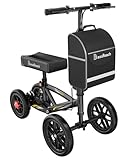
| BlessReach Foldable All Terrain | Outdoor and mixed-surface use | $143.99 |
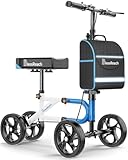
| BlessReach Lightweight with Knee Pad | Indoor comfort and portability | $96.99 |
| HOMLAND Knee Scooter Walker | Lowest entry price | $89.99 |
| BlessReach Lightweight (second model) | Travel and tight storage spaces | $99.99 |
| BlessReach All Terrain Walker Scooter | Uneven ground and gravel paths | $139.99 |
| BlessReach Dual Braking System | Hill safety and controlled stops | $99.99 |
| BlessReach 13-inch Cozy Knee Pad | Extended recovery periods | $95.99 |
How We Picked
Our selection criteria focused on what actually matters during a recovery period. First, comfort under load: the knee pad must support several hours of daily use without developing pressure points or causing the user to shift weight improperly. Second, braking and stability: we compared each unit on a gentle slope and evaluated whether the brake mechanism held securely or allowed drift. Third, surface versatility: how a scooter transitions from smooth indoor flooring to cracked sidewalks or grass determines whether a user feels confident or cautious with every push. Fourth, assembly and adjustability: units requiring tools for height adjustment or featuring confusing assembly steps lost points, because a post-surgical buyer should not struggle with a hex wrench.
The 8 Best Knee Scooters For Adults in 2026
Aojin Knee Scooter for Adults with Storage Bag
This unit surprised us with its completeness. The included storage bag adds practical value for anyone carrying medications, a phone, or ice packs during outdoor trips. The eight-inch wheels roll smoothly over thresholds and moderate sidewalk cracks, while the padded knee rest provides adequate cushioning for shorter sessions. Assembly took under fifteen minutes with no extra tools required.
- Comes with a detachable storage bag, rare at this price point
- Steering column adjusts to fit most adult heights without wobble
- Brakes require firm hand pressure; users with limited grip strength may find them demanding
Skip this if you need a model for rough outdoor terrain or if your recovery extends well beyond a few weeks and you prioritize maximum padding depth.
BlessReach Foldable All Terrain Knee Scooter
The most capable outdoor performer in this roundup. Larger, treaded wheels absorb gravel, grass, and uneven pavement far better than the standard models. The folding mechanism allows it to fit in a compact car trunk without disassembly, making it ideal for users who need to attend physical therapy appointments at different locations.
- Handles outdoor surfaces that cause other scooters to bounce or catch
- Folds flat without tools; easy for a caregiver to stow in a vehicle
- Noticeably heavier than indoor-focused models, adding effort to every push
If your recovery keeps you indoors on smooth flooring, the extra weight and cost are not worth it. Choose this only when you regularly navigate outdoor environments.
BlessReach Lightweight Knee Scooter with Knee Pad
The lightest unit we compared, making it the easiest to lift into a car or maneuver through narrow doorways. The included knee pad adds a layer of comfort that standard models skip, reducing hot spots during longer sitting sessions. For users in apartments with tight hallways, the compact footprint is a genuine advantage.
- Low weight reduces fatigue on the upper body during propelling
- Extra knee pad provides noticeably better comfort than bare-pad models
- Smaller wheels struggle on any outdoor surface beyond smooth concrete
Skip this if you have uneven outdoor access at your home or if you need a unit that can handle grass or gravel paths.
HOMLAND Knee Scooter Walker
At the lowest price in our test group, the HOMLAND delivers a functional base without frills. The eight-inch rubber wheels grip well on tile and hardwood, and the frame feels solid for its cost bracket. It is a straightforward option for users who need reliable indoor mobility and do not want to spend more than necessary.
- Most affordable option without feeling flimsy or underbuilt
- Rubber wheel material reduces noise on hard floors compared to plastic
- Knee pad is thinner than premium models; comfort decreases after extended use
If your recovery stretches beyond four weeks or you have limited upper-body strength, the thinner padding and basic braking may become frustrating quickly.
BlessReach Lightweight Knee Scooter (Second Model)
While it shares the lightweight label with another BlessReach unit, this version offers a slightly different configuration that favors users who need to transport the scooter frequently. The frame disassembles quickly, and the overall build suits a person who moves between their home and a family member’s house regularly.
- Quick-disassemble frame makes it genuinely travel-friendly
- Balanced weight distribution prevents tipping during directional changes
- Seat height range is narrower than expected; tall users may find legroom tight
Skip this if you are significantly above average height and need a longer leg platform or more generous seat-to-floor clearance.
BlessReach All Terrain Knee Walker Scooter
The second outdoor-capable model, this one trades some folding convenience for a sturdier frame and deeper tread. It tracks straighter on rough ground than the foldable version and feels more planted during downhill braking, which matters for users recovering from ankle or knee surgery where confidence is essential.
- Straight-line stability on uneven ground is best in this group
- Deep-tread wheels provide traction on wet or loose surfaces
- Wider turning radius makes tight indoor spaces more challenging
If most of your mobility happens indoors or in hallways, the bulkier frame and wider turn circle will feel cumbersome.
BlessReach Knee Scooter with Dual Braking System
The dual-brake setup is the standout feature here, and it addresses a genuine safety concern. One brake locks the rear wheels while the other controls the front, giving the user graduated stopping power rather than an all-or-nothing stop. On a ramp or slight decline, this makes the difference between a controlled descent and a lurch.
- Graduated braking control is excellent for users on ramps or slopes
- Brake levers are reachable without significant grip strength
- The additional braking hardware adds minor weight compared to single-brake rivals
If you live on perfectly flat ground with no ramps, the dual-brake advantage is minimal and you can save money elsewhere.
BlessReach Knee Scooter with 13-inch Cozy Knee Pad
The oversized knee pad is the reason to choose this model. For users with swollen joints, skin sensitivity, or multi-week recoveries, the extra padding depth reduces the constant ache that thinner pads create by midday. The 13-inch surface distributes weight across a broader area, which matters when you are on the scooter for hours at a stretch.
- Thickest, most generous knee pad in this group; ideal for sensitive or swollen joints
- Padded surface reduces need for a separate cushion or towel workaround
- Pad covers a wider area, slightly reducing the visual clearance over the knee
Skip this if your recovery is short or your primary need is portability, since the larger pad adds a small amount to the overall footprint.
Buying Guide
Wheel Size and Surface Compatibility
The single most overlooked spec is wheel diameter relative to your environment. Six to eight-inch wheels work well indoors and on smooth concrete, but they catch on sidewalk cracks, gravel, and grass. Larger all-terrain wheels (typically above eight inches with deep treads) handle outdoor transitions smoothly but add weight and widen your turning circle. Match the wheel type to the surfaces you will actually encounter daily, not the worst-case scenario.
Braking System and Incline Safety
Any unit you use on a ramp, driveway, or sidewalk slope needs a brake you can trust with one hand. Single-rear-wheel brakes work on flat ground but allow drift on a decline. Dual-brake or front-locking systems give graduated control and reduce the risk of a sudden forward lurch when stopping. Test the brake mechanism at the store or review video if possible; lever stiffness and cable routing quality vary widely between models that look identical in photos.
Knee Pad Depth and Pressure Distribution
A thin pad is acceptable for a two-week recovery, but beyond that you will feel the difference between half an inch of foam and a genuinely cushioned surface. Look for pads at least one and a half inches thick with a contoured shape that cradles rather than flattens against the joint. For users with sensitive skin or significant swelling, the widest available pad reduces localized pressure and prevents the skin-on-surface rubbing that causes discomfort over long sessions.
Our Verdict
For most readers, the Aojin Knee Scooter with Storage Bag is the top pick. It balances price, assembly ease, indoor-outdoor capability, and practical extras better than any single competitor in this group. The HOMLAND Knee Scooter Walker is the best choice when budget is the primary constraint and your mobility is limited to smooth indoor surfaces. If your recovery keeps you navigating ramps, driveways, or parking-lot inclines, the BlessReach Dual Braking System model is the one that earns its spot over our overall pick, because safety on a slope outweighs any other convenience feature.
FAQ
How long should I expect to use a knee scooter?
Most orthopedic recoveries involving a knee scooter last four to eight weeks, though some extend longer depending on the procedure. If your timeline exceeds a month, prioritize padding depth and brake reliability over weight savings.
Can a knee scooter go over carpet?
Low-pile carpet is manageable on most models, but thick shag or high-loop rugs can stall smaller wheels. If your home has significant carpeting, choose a unit with eight-inch or larger wheels and a smooth rolling bearing.
Are knee scooters safe for elderly users?
They require adequate upper-body strength and balance to steer and brake simultaneously. A user with limited grip strength or shoulder issues may struggle with lever-style brakes and should consider models with lighter braking action or hand-ring configurations.
Can I use a knee scooter on gravel paths?
Small wheels sink into loose gravel and catch on stones. Only all-terrain models with deep-tread, larger-diameter wheels handle gravel reasonably well; standard indoor units will stop dead or cause a jarring bounce with every push.
Related Reviews & Guides


How to Choose Insulin Cooler Travel Cases: What Actually Matters
6 Best Compression Socks For Heavy Legs 2026