Last Updated: September 27, 2026
No new power wheelchair costs under $100. Even the simplest folding models are priced in the thousands, and a listing that offers a new power chair for a two-digit price is almost certainly a scam, a toy or a misdescribed accessory. That does not mean a senior with a small budget cannot get a power wheelchair. It means the $100 is better spent getting through the systems that pay for power mobility, or on the accessories and maintenance that keep an existing chair working. This guide explains the realistic ways to obtain a power wheelchair for little or no out-of-pocket cost, and what $100 can sensibly buy.
Quick answer: For most people in 2026, the best power wheelchair under $100 for seniors is the Original Medicare Part B — our #1 rated choice. See the full ranked comparison, alternatives and buying advice below.
Why $100 is not a realistic purchase price
A power wheelchair combines two motors, a controller, a joystick, batteries, a charger and a seating system. Batteries alone typically cost $150 to $400 per set. New consumer power chairs generally run from about $1,500 to $5,000, and complex rehab chairs cost far more. Online listings at a tiny fraction of that price are a common scam pattern: fake storefronts that take payment and ship nothing. Never pay by wire transfer or gift card for mobility equipment.
Routes to a power wheelchair with little or no cost
| Route | What it can provide | Typical out-of-pocket |
|---|---|---|
| Original Medicare Part B | New power chair if strict criteria are met | 20 percent coinsurance after deductible; Medigap may cover it |
| Medicaid | Power chair with prior approval | Often little or nothing |
| Medicare Advantage | Power chair through plan suppliers | Plan copay or coinsurance |
| VA | Power mobility for eligible veterans | Usually none |
| Disease-specific charities | Loaned equipment for conditions such as ALS or MS | Often free |
| State assistive technology reuse programs | Refurbished chairs | Free or low cost |
How the Medicare process works
The face-to-face exam
A doctor, nurse practitioner or physician assistant must see the person and document that they cannot complete daily activities inside the home, such as toileting, dressing or getting to the kitchen, using a cane, walker or manual wheelchair, and that they can safely operate a power chair.
The written order and supplier
The clinician sends an order to a Medicare-enrolled supplier, which may visit the home to confirm the chair will fit through doorways and around furniture. Some chairs need prior authorization.
Your share
You pay 20 percent of the Medicare-approved amount after the annual Part B deductible. A Medigap supplement often covers that 20 percent, and people with Medicaid as well as Medicare may pay nothing.
Free and loaned equipment
Many communities have medical equipment loan closets run by churches, senior centers, service clubs or hospice programs. National and local organisations for ALS, multiple sclerosis and muscular dystrophy often maintain equipment loan programs for members. Every state has an Assistive Technology Act program that can direct you to device loans and reuse programs where donated chairs are cleaned, repaired and matched to new users. The Eldercare Locator and the local Area Agency on Aging are good starting points.
What $100 can sensibly buy
| Item | Typical cost | Why it helps |
|---|---|---|
| Pressure-relief seat cushion | $40–$100 | Protects skin during long sitting |
| Joystick knob or extension | $15–$40 | Easier control for weak or arthritic hands |
| Rain cover or poncho | $20–$50 | Protects rider and electronics |
| Under-seat or side bag | $15–$40 | Keeps hands free and weight balanced |
| Replacement charger fuse or cable | $10–$40 | Cheap fix for a common failure |
Check that any accessory fits the specific chair, and ask the supplier before modifying seating, which can affect posture and skin.
Stretching a small budget with maintenance
If the senior already has a power chair, $100 spent on upkeep often buys more mobility than any purchase. Charge the batteries fully every night rather than topping up occasionally, keep tires at the pressure printed on the sidewall if they are pneumatic, and wipe the joystick boot so moisture cannot creep into the controller. Many breakdowns start with a loose battery connector or a worn charger cable, both cheap to fix when caught early. If the chair came through Medicare, ask the supplier about covered repairs before paying anyone yourself.
FAQ
Can I rent a power wheelchair cheaply?
Short-term rentals exist, but they usually cost more than $100 per week. Medicare may cover some power chairs on a rental basis in its own payment structure, which the supplier manages.
What if Medicare denies the power chair?
Ask for the reason in writing. Denials often stem from incomplete documentation, which the clinician can address. You can also appeal, and a therapist’s mobility evaluation often strengthens the case.
Bottom line
There is no genuine power wheelchair for under $100. The best use of a small budget is to pursue Medicare, Medicaid, VA or charity routes that can supply a chair at low or no cost, and to spend the $100 on a good cushion or control accessories. Treat any cheap new power chair listing as a probable scam.
Ready to decide? Our #1 pick for 2026 is the Original Medicare Part B.
Live price & availability on Amazon.
Related Reviews & Guides




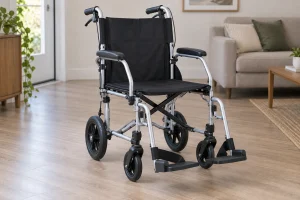
How Much Does a Wheelchair Cost in 2026?
Walk-in Tub vs Walk-in Shower for Seniors