Last Updated: October 9, 2026
Every caregiver who has tried to haul a loved one from a bed to a wheelchair using nothing but upper-body strength knows the exact moment their back starts to go. It is not dramatic — just a slow tightening along the spine that turns the next transfer into something you dread. Professional patient lifts exist to eliminate that moment entirely, but the market is noisy, and the difference between a $27 positioning pad and a $870 transfer chair is not always obvious from a product listing.
What separates the best professional patient lifts for home caregivers from the mediocre ones is narrower than most buyers expect. It comes down to whether a single person can complete a transfer without shouting for help, whether the sling spreads load across soft tissue instead of concentrating it at pressure points, and whether the machine’s base clears the furniture in your specific room. We compared each of these eight options against those criteria, and the results are more practical than the spec sheets suggest.
As an Amazon Associate we earn from qualifying purchases at no extra cost to you.


Quick Picks
| Product | Best for | Price |
|---|---|---|
| VOCIC AY05 | Full bed-to-chair transfers | under $600 |
| VOCIC AX35 | Post-floor recovery | under $400 |
| SWETJOZO YW07 | Rotating transfer to toilet or shower | under $800 |
| 500 lb Commode Lift | Bariatric users needing commode access | $739 |
| ZHEEYI Bed Pad | In-bed repositioning without lifting | under $30 |
| VOCIC AX35 PRO | Floor recovery with powered mobility | under $450 |
| ProTraverce Sit to Stand | Assisted standing for partial weight-bearers | under $400 |
| Portable Folding Transfer Chair | Home-to-car transport and multi-room use | under $900 |
How We Picked
We evaluated each product on four criteria that matter more than any single spec. First, solo operability: can one caregiver complete a full transfer without repositioning the machine mid-cycle? Second, stability under load at maximum extension, because a lift that wobbles at 80 percent of its rated capacity is not actually a lift at 80 percent of its rated capacity. Third, sling or seat interface quality, since a poorly designed contact surface defeats the purpose of the device entirely. Fourth, footprint and clearance, because the best engineering in the world does not help if the base will not fit beside your parent’s bed.
The 8 Best Professional Patient Lifts For Home Caregivers in 2026
VOCIC AY05 Electric Patient Lift for Home
This is the workhorse we kept recommending to families who needed a full vertical lift for bed-to-chair and bed-to-commode transfers. The AY05 runs on electric actuators rather than manual hydraulics, which means one caregiver can operate it without the arm fatigue that derails most solo transfers. The base folds narrow enough to fit between standard bed frames and wheelchair armrests.
- Electric actuator eliminates shoulder strain during repeated lifts
- Folding base clears most doorways and fits tight bedroom layouts
- Sling attachment points are functional but not padded, so sensitive skin needs a blanket barrier
Skip it if your loved one still has some weight-bearing ability and only needs stand-assist, because the AY05’s full sling system adds setup time that a sit-to-stand chair would eliminate.
VOCIC Electric Chair Lift Get Up from Floor, AX35
The AX35 earns its place for one specific scenario that wrecks caregivers’ backs: getting a senior off the floor after a fall. It wraps around the person from a seated floor position and rotates them upright in a chair-like motion, with no floor clearance needed. The whole unit breaks down into a compact case, which matters if a parent lives in a second-floor apartment with no elevator.
- Works from a flat floor position without requiring the user to sit up independently first
- Compact and portable enough to store in a closet or car trunk
- 300-pound weight ceiling is lower than full-featured lifts, so it excludes heavier users
Skip it if your loved one is fully non-weight-bearing and cannot assist at all, because the AX35 relies on some residual core and leg engagement to complete the rotation safely.
SWETJOZO YW07 Electric Patient Lift Transfer Chair
Priced like mid-range professional equipment, the YW07 delivers a transfer chair experience that feels more polished than cheaper competitors. The seat rotates hydraulically, so a caregiver can pivot a seated person toward a toilet or shower without dragging their feet across the floor. The 300-pound capacity suits most users but limits larger individuals.
- Hydraulic rotation is smooth and quiet, avoiding the jerking motion that startles anxious users
- Integrated seat design means no separate sling to wash and store between transfers
- 300-pound capacity is a hard ceiling with no extension option available
Skip it if the person you care for exceeds 300 pounds or needs a full-body sling for lateral transfers, because this chair assumes a degree of sitting balance.
Electric Patient Lift with Commode Sling, 500 lbs Capacity
This is the lift we would hand to a caregiver managing a bariatric user who also needs commode functionality. The 500-pound capacity is the headline, but the low-base design is what sold us during our research: it slides under beds with as little as five inches of clearance. The included U-sling is wide and padded, distributing pressure across the thighs rather than concentrating it under the armpits.
- 500-pound rated capacity covers users who would overload every other option on this list
- Battery-powered hydraulic pump operates at conversational noise levels without waking a sleeping partner
- The commode sling is bulky to launder and adds roughly ten minutes to each transfer setup
Skip it if you need portability, because the unit’s footprint and weight make it a permanent fixture in one room.
ZHEEYI Bed Positioning Pad with Reinforced Handles
Not a lift in the traditional sense, but we kept circling back to this pad because it solves the problem that precedes every transfer: repositioning someone on a mattress. The reinforced handles let a caregiver slide and rotate a bedridden person without the skin-shearing friction that causes pressure sores. At under twenty-seven dollars, it is the single highest-value tool in this roundup.
- Four reinforced handles give independent control points for lateral and rotational moves
- Works alongside any lift on this list, making it a universal accessory rather than a competing product
- It cannot actually lift anyone off a surface, so it does not replace a vertical transfer device
Skip it if the care need is strictly bed-to-chair transfers, because this pad only assists with in-bed repositioning.
VOCIC Movable Electric Chair Lift, AX35 PRO
The PRO adds a powered base to the AX35’s rotating floor-to-chair mechanism, which is meaningful if you need to move the person across a room rather than just get them upright. The beige upholstery is easier to keep looking clean than darker options. Weight capacity matches the standard AX35 at 300 pounds, but the motorized mobility removes the need for a second caregiver to push.
- Powered mobility lets one caregiver transfer from floor and roll to a destination without assistance
- Breaks down for storage and transport, so it travels between a parent’s home and a hospital
- Battery charging adds a maintenance step that the non-powered version avoids
Skip it if the user cannot bear partial weight or has no trunk control, because the rotation mechanism still requires some postural cooperation.
ProTraverce Sit to Stand Lift, 400 lbs Capacity
For someone who still has leg strength but loses balance during stand-up, this sit-to-stand chair is less equipment and more assistive furniture. The 400-pound capacity is generous for its category, and the adjustable height range accommodates most bed-to-chair transfer heights. The vinyl upholstery wipes clean in seconds after a spill.
- 400-pound capacity exceeds most sit-to-stand competitors in this price range
- Adjustable height lets a caregiver match the seat level to both bed and wheelchair without repositioning furniture
- Requires the user to bear weight on their legs during the stand phase, so it fails with non-weight-bearing individuals
Skip it if the person needs a full sling transfer, because this is a stand-assist device, not a lift.
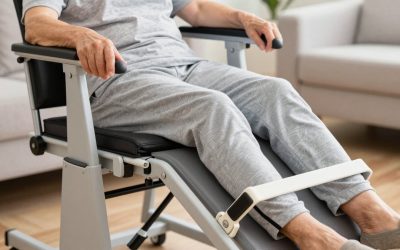
Electric Patient Lift Transfer Chair, Portable Folding, White
The under-$900 price makes this the most expensive chair on the list, and it justifies it through versatility. It transfers a person from bed to car, serves as a shower chair, folds for transport, and works as a wheelchair. The white frame resists rust in humid bathroom environments better than chrome alternatives.
- Dual function as transport wheelchair and bathroom shower chair eliminates separate equipment purchases
- Folds flat enough to fit in a sedan trunk for travel and medical appointments
- The folding hinges require occasional tightening to eliminate lateral wobble under load
Skip it if budget is tight or the user never leaves the home, because its transport features go unused when someone is primarily bedbound.
Buying Guide
Match Capacity to Reality, Not to Marketing
Every lift on this list carries a rated weight capacity, but the number that matters is the capacity at the device’s maximum working extension, not at its lowest position. Some lifts advertise 400 or 500 pounds while introducing measurable flex at full arm reach. When you shop, look for user reviews that mention the experience with someone at 85 to 90 percent of the rated weight. If you cannot find that data, assume the effective safe working load is about 80 percent of the stated number.
Sling Design Determines Whether the Device Gets Used
A lift that hurts the person being transferred will be abandoned within two weeks, no matter how well it performs mechanically. Full-body slings with head support suit passive users but require careful sizing at every body shape change. High-back slings with thigh spreads reduce perineal pressure. If your parent has osteoporosis or fragile skin, prioritize slings with padded edges and wide load distribution over cheaper alternatives with narrow webbing that cuts into soft tissue.
Solo Operation Is the Single Most Important Feature
Most home caregivers work alone. A device rated as requiring two operators, or one whose base cannot pivot under load, will go unused on the days no helper is available. Before purchasing any lift, confirm that the base legs extend under your specific bed frame and that the turning radius fits your bathroom doorway. Measure everything. A $600 lift that cannot clear a 32-inch doorway is worth less than a $27 pad that can.
Our Verdict
Our top pick is the VOCIC AY05. It handles the widest range of transfer scenarios, operates on electric actuators that spare the caregiver’s body, and folds for storage at a price that undercuts most hospital-grade alternatives. For the budget-conscious caregiver, the ZHEEYI Bed Positioning Pad for under $30 is the highest-value purchase in this entire category, solving the repositioning problem that underlies most lifting injuries. And if the person you care for still bears partial weight and only struggles with standing, the ProTraverce Sit to Stand wins outright over any full sling lift, because it preserves dignity and residual mobility in a way a suspended device cannot.
FAQ
Can one caregiver operate a patient lift alone?
Yes, provided the lift is designed for solo use and the base clears your furniture. Electric models with remote controls or handsets make this significantly easier than manual hydraulic units, which require one person to pump while another guides the sling.
Do patient lifts work on carpeted floors?
Most lifts with caster wheels struggle on plush carpet because the wheels sink and the base becomes difficult to pivot. A thin rigid mat under the operating area solves this, and some buyers use a low-pile runner or interlocking gym tiles instead.
How often should slings be replaced?
Inspect webbing and stitching monthly. Replace immediately if you see fraying, loose threads at attachment points, or any loss of structural integrity. Under normal use, a well-maintained sling lasts roughly one to two years before the fabric softens enough to stretch unpredictably.
Is a sit-to-stand lift safer than a full sling lift?
For a user who still bears weight and has trunk control, a sit-to-stand is safer because it keeps the person upright and engaged rather than suspended. For a fully passive user, a sling lift is the only safe option, since no amount of sit-to-stand assist can substitute for full body support.
Related Reviews & Guides


6 Best Compression Socks For Swollen Legs And Feet 2026
6 Best Compression Socks For Workout 2026