Last Updated: September 26, 2026
Smart home technology can quietly make life safer and easier for an older adult who lives alone. Voice-controlled lights prevent stumbling in the dark, video doorbells help screen visitors and scammers, sensors can alert family to unusual inactivity, and smart plugs can switch off a forgotten iron. The right devices support independence without making the home feel like a hospital. This guide covers the most useful categories, how to prioritize and how to set them up so they actually help.
Quick answer: For most people in 2026, the best smart home devices for elderly living alone is the Motion-activated lights — our #1 rated choice. See the full ranked comparison, alternatives and buying advice below.
Goals Before Gadgets
Start by listing the specific worries or challenges: falls at night, forgetting to lock the door, loneliness, missed medications, scam callers, a stove left on. Then choose devices that address those needs. Adding too many gadgets at once can overwhelm and frustrate.

Smart Caregiver Economy Wireless Monitor and Motion Sensor
Included for 'Best Smart Home Devices for Elderly Living Alone' as a relevant option in this category; details come from the product listing.
View on AmazonSafety and Security Devices
Smart lighting and motion-activated lights
Lights that turn on automatically when someone gets out of bed or enters a hallway reduce night-time falls. Voice control helps people with limited mobility.
Video doorbells
See and speak to visitors without opening the door, helpful for screening strangers and reducing doorstep scams.
Smart locks
Keypad or app-controlled locks remove the need for keys and let trusted family or carers in during emergencies. Choose models with a physical key or keypad backup.
Smart smoke and carbon monoxide detectors
Send alerts to family phones, not just a local alarm, which matters for people with hearing loss.
Stove and appliance safety
Smart plugs and stove shut-off devices can turn off appliances automatically or remotely.
Water leak sensors
Detect overflowing sinks or baths, useful for people with memory concerns.
Health and Wellbeing Devices
Activity sensors
Motion and door sensors learn daily patterns and alert family if, for example, there is no movement by mid-morning.
Medical alert with fall detection
A wearable that summons help after a fall, even if the person cannot press a button.
Smart displays and speakers
Provide reminders, video calls, music and news, helping with loneliness and routines.
Smart pill dispensers
Alarm and lock medication doses, with alerts to caregivers.
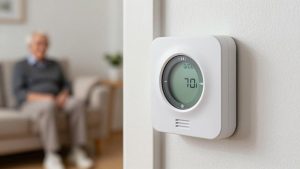
Smart thermostats
Maintain safe temperatures and let family adjust heating remotely during heat waves or cold spells.
| Device | Main benefit | Typical price range | Priority |
|---|---|---|---|
| Motion-activated lights | Fewer night falls | $15–$60 | High |
| Medical alert with fall detection | Help after falls | $0–$200 + $25–$45/month | High |
| Video doorbell | Screen visitors, scams | $60–$200 | High |
| Smart smoke/CO detector | Remote alerts | $40–$130 | High |
| Activity sensor kit | Inactivity alerts | $100–$300 | Medium to high |
| Smart speaker/display | Reminders, connection | $30–$250 | Medium |
| Smart lock | Keyless entry, carer access | $100–$300 | Medium |
| Smart plugs | Appliance control | $10–$25 each | Medium |
| Smart thermostat | Safe temperatures | $100–$250 | Medium |
Choosing a Platform
Most smart home devices work within an ecosystem controlled by an app or voice assistant. Choosing one ecosystem and sticking with it simplifies setup and control. Make sure the app allows multiple users so family members can help manage devices remotely.
Setup and Support Tips
- Check Wi-Fi strength throughout the home; add a mesh system if there are dead spots.
- Install devices gradually, one or two at a time, so the person can adjust.
- Label devices and write simple instructions in large print.
- Set up automations that require no action, such as night lights that switch on automatically.
- Arrange backup power or battery options for critical devices.
- Review privacy settings and agree on what family can see.
Respecting Privacy and Independence
Discuss every device with the person before installing it. Sensors that show activity patterns without images are often more acceptable than cameras. The aim is support, not surveillance. Agree on who receives alerts and how the information will be used.
FAQ
Do smart home devices need Wi-Fi?
Most do. Some medical alerts and sensors use cellular connections instead. If the home lacks reliable internet, choose cellular devices for critical safety functions.
Are smart home devices hard for seniors to use?
Many work automatically once set up, such as motion lights and sensors. Voice control makes others easier. Family setup and simple instructions help a lot.
Bottom line
For an elderly person living alone, the best smart home devices start with motion lighting, a medical alert with fall detection, a video doorbell and connected smoke detectors, then add activity sensors, voice assistants and smart plugs as needed. Choose devices that solve real problems, install gradually and respect privacy. Smart technology can help home stay the safest place to be.
Ready to decide? Our #1 pick for 2026 is the Motion-activated lights.
Live price & availability on Amazon.
Related Reviews & Guides



Best OXO Good Grips for Arthritis

Walk-in Tub vs Walk-in Shower Which Is Better for Seniors