Last Updated: September 27, 2026
Many older adults notice the same early signs: the TV creeps louder, restaurant conversations blur together, and grandchildren’s voices seem to vanish at the ends of sentences. At that point two very different products show up in search results, hearing aids and personal sound amplifiers, and they are often priced and marketed as if they were interchangeable. They are not. One is a medical device built to correct a specific pattern of hearing loss; the other simply makes everything louder. This comparison explains how each works, what the regulations mean for you, and how to decide which one fits your situation.
Quick answer: Our top pick in 2026 is the Intended user — our #1 rated choice. See the full ranked comparison, alternatives and buying advice below.
What Each Device Actually Does
Hearing aids
A hearing aid is designed to compensate for hearing loss. Age-related loss (presbycusis) usually hits high frequencies first, the range where consonants like “s”, “f” and “th” live. A hearing aid boosts those frequencies more than low ones, compresses loud sounds so they do not become painful, and often reduces steady background noise. Since the US over-the-counter rule took effect in 2022, adults 18 and older with perceived mild to moderate loss can buy OTC hearing aids without a prescription, while prescription aids fitted by an audiologist remain the route for moderate-to-severe or complex loss.

Karthus Hearing Aids for Seniors with Noise Reduction, Rechargeable In-Ear
Included for 'Hearing Aid vs Hearing Amplifier Which Is Better for Seniors' because the listing specifies Rechargeable In-Ear, details this guide uses to compare options.
View on Amazon
Oricle Hearing Aids for Seniors - Oricle Hearing Aids for Adults with Advanced Noise Cancellation - Easy Volume Control with Portable Charging Case
Included for 'Hearing Aid vs Hearing Amplifier Which Is Better for Seniors' because the listing specifies Easy Volume Control with Portable Charging Case, details this guide uses to compare options.
View on Amazon
Audien Atom X OTC Hearing Aid For Seniors & Adults with Touchscreen Control
Included for 'Hearing Aid vs Hearing Amplifier Which Is Better for Seniors' as a relevant option in this category; details come from the product listing.
View on Amazon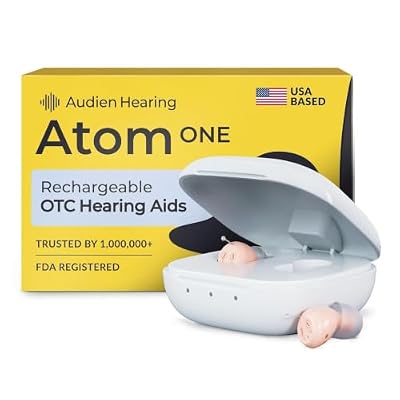
Audien Atom One OTC Hearing Aids
Included for 'Hearing Aid vs Hearing Amplifier Which Is Better for Seniors' as a relevant option in this category; details come from the product listing.
View on AmazonHearing amplifiers (PSAPs)
A personal sound amplification product is intended for people with normal hearing who want a boost in specific situations, such as bird watching or listening to a lecture from the back row. Most PSAPs amplify a broad range of sound fairly evenly. For someone with genuine high-frequency loss, that means vowels and background rumble get louder along with the consonants, so speech can seem louder without becoming clearer.
Side-by-Side Comparison
| Factor | Hearing aid (OTC or prescription) | Hearing amplifier (PSAP) |
|---|---|---|
| Intended user | Adults with hearing loss | People with normal hearing |
| Frequency shaping | Targets the frequencies you have lost | Mostly uniform boost |
| Noise handling | Directional mics, noise reduction on most models | Limited or none on budget units |
| Typical price per pair | OTC $200–$1,500; prescription $1,500–$6,000 | $30–$400 |
| Fitting and follow-up | App self-fit or audiologist visits | None |
| Regulation | FDA-regulated medical device | Consumer electronics |
Who Should Choose Which
Signs a hearing aid is the better fit
If you consistently ask people to repeat themselves, struggle more with women’s and children’s voices, or find group conversations exhausting, the pattern points to hearing loss rather than a situational need. A hearing aid tuned to your loss will usually give clearer speech at a lower overall volume, which also means less listening fatigue by evening.
When an amplifier can make sense
A PSAP can be a reasonable stopgap if a hearing test shows normal or near-normal hearing and you only want help in quiet, specific settings, like hearing a pastor in a large church. Some people also keep an inexpensive amplifier as a backup while a hearing aid is being repaired. What a PSAP should not do is replace an evaluation when you suspect real loss.
Get a Hearing Test First
A baseline hearing test from an audiologist or a well-validated app gives you an audiogram, a chart showing which frequencies you hear at which volume. That chart decides almost everything: whether OTC aids are appropriate, how much gain you need, and whether one ear is worse. Many clinics offer free or low-cost screenings, and Medicare Part B may cover a diagnostic exam when ordered by a doctor.
See a clinician promptly, rather than buying any device, if you notice sudden hearing loss, loss in only one ear, ear pain or drainage, ringing in one ear, or dizziness. These can signal conditions that need medical care, and sudden loss in particular is time-sensitive.
Practical Buying Criteria
Comfort and handling
Seniors with arthritis or reduced finger sensation should look closely at battery type. Rechargeable aids that drop into a charging case avoid fiddly size 10 or 312 batteries. Behind-the-ear styles are easier to handle than tiny in-canal units.
Controls and apps
Physical volume buttons are helpful for people who do not use smartphones. If the device relies on an app for adjustments, make sure a family member can help set it up and that the app has large text.
Trial period and support
Look for a return window of at least 30 to 45 days. The brain needs two to four weeks to adapt to amplified sound, so judge the device after that period, not after the first day.
Cost Beyond the Sticker Price
Budget for batteries or charger replacement, domes and wax guards ($10–$30 every few months), and cleaning supplies. Prescription aids often bundle several years of adjustments, which can make the higher price more reasonable over time. Some Medicare Advantage plans include hearing aid allowances, so check your plan documents before buying.
FAQ
Can a hearing amplifier damage my hearing?
Any device that plays sound loudly for long periods can contribute to further hearing damage. Budget amplifiers without output limits are the bigger concern, so keep the volume at the lowest level that lets you understand speech.
Are over-the-counter hearing aids good enough?
For many adults with mild to moderate loss, OTC hearing aids work well, especially models with an in-app hearing test for self-fitting. People with severe loss, uneven loss between ears, or other ear conditions usually do better with a professional fitting.
Bottom Line
If you have real, measurable hearing loss, a hearing aid, OTC or prescription, is the better choice because it restores clarity rather than raw volume. A hearing amplifier is only a sensible pick for people with essentially normal hearing who want situational help. Start with a hearing test, give any new device a few weeks of adjustment, and bring unusual symptoms to a doctor before buying anything.
Ready to decide? Our #1 pick for 2026 is the Intended user.
Live price & availability on Amazon.
Related Reviews & Guides

6 Best Covers For Wheelchair Cushion 2026

Hemi Walker vs Standard Walker: Which Is Right for Your Home (2026)