Last Updated: October 6, 2026
- Top Picks at a Glance
- Incontinence Types: Why Category Matters for Product Selection
- Product Category Comparison
- Absorbency Ratings: What the Numbers Mean
- Skin Health: The Clinical Priority Caregivers Often Miss
- Sizing and Fit: The Most Underestimated Factor
- Caregiver Logistics: Changing Frequency and Supply Management
- Related Resources
- Related Guides
- Frequently Asked Questions
- Related Articles
TL;DR: Adult incontinence products range from light bladder leak pads to full absorbency briefs — wrong product for the severity level wastes money and fails at the critical moment. Match product to incontinence type (stress, urge, overflow, functional) and output volume. Top comparison below covers briefs, pull-ons, pads, and underpads by absorption level, fit, and caregiver usability.
Incontinence Products for Adults: Evidence-Based Comparison Guide for Caregivers in 2026
Adult incontinence affects an estimated 25–33% of adults over 65. It’s the second leading reason for nursing home placement after cognitive decline — not because it’s medically unmanageable, but because caregivers and seniors lack access to the product knowledge and clinical framework to manage it effectively at home. The wrong product, improperly fitted, used for the wrong incontinence type, creates skin breakdown, leakage, and the social withdrawal that makes the condition more isolating than it has to be.

4 Pack Waterproof Reusable Heavy Absorbency Incontinence Bed Pads 34"x36"
Included for 'Incontinence Products for Adults' as a relevant option in this category; details come from the product listing.
View on Amazon
Adult Diapers for Women, Maximum Absorbency Incontinence and Postpartum Underwear Size S/M, Up to 100% Leak Free Bladder Leak Protection, 84 Count
Included for 'Incontinence Products for Adults' because the listing specifies Up to 100% Leak Free Bladder Leak Protection and 84 Count, details this guide uses to compare options.
View on Amazon
FitRight Extra+ Adult Diapers, Disposable Incontinence Briefs, Leak-Proof Diaper, Absorbent Briefs For Men and Women, Maximum Protection, X-Large, 56 – 64 in, 20 briefs per bag
Included for 'Incontinence Products for Adults' because the listing specifies Disposable Incontinence Briefs and Leak-Proof Diaper, details this guide uses to compare options.
View on Amazon
OPTEEL Adult Wipes for the Elderly – Extra Large 8x13, Pre-Moistened 720ct
Included for 'Incontinence Products for Adults' because the listing specifies Extra Large 8x13 and Pre-Moistened 720ct, details this guide uses to compare options.
View on Amazon
IMPROVIA® Washable Underpads, Heavy Absorbency Reusable Incontinence Pads
Included for 'Incontinence Products for Adults' because the listing specifies Heavy Absorbency Reusable Incontinence Pads, details this guide uses to compare options.
View on Amazon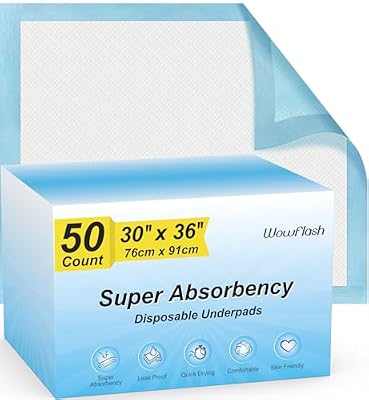
50 Count 30” x 36” Super Absorbency Disposable Underpads
Included for 'Incontinence Products for Adults' as a relevant option in this category; details come from the product listing.
View on Amazon
FitRight Ultra Adult Diapers, Disposable Incontinence Briefs, Leak-Proof Diaper, Absorbent Briefs For Men and Women, Maximum Protection, Medium, 32 – 44 in, 20 briefs per bag
Included for 'Incontinence Products for Adults' because the listing specifies Disposable Incontinence Briefs and Leak-Proof Diaper, details this guide uses to compare options.
View on Amazon
Because Overnight Booster Pads Fit All Adult Diapers, Helps Keep Your Adult Diaper Active All Night, Adds 4 Cups to Incontinence Underwear, Extra Absorbency, 45 Count
Included for 'Incontinence Products for Adults' because the listing specifies Helps Keep Your Adult Diaper Active All Night and Adds 4 Cups to Incontinence Underwear, details this guide uses to compare options.
View on AmazonThis is a product comparison guide, not a medical guide — but it’s grounded in the clinical categories that certified wound and continence nurses (CWOCNs) and continence nurse practitioners use to guide product selection. Understanding the clinical context behind product categories makes buying decisions significantly more accurate than reading package descriptions alone.
Top Picks at a Glance

MCombo Power Lift Recliner Chair for Elderly 7141(Grey, Small)
Included for 'Incontinence Products for Adults' because the listing specifies Small), details this guide uses to compare options.
View on Amazon
Carex 3.5 Inch Raised Toilet Seat with Arms, Elongated Toilet Seat Riser, Up to 250 lbs Capacity, Elevating & Raising Seat for Elderly & Handicap, Universal, Slip-Resistant with Padded Handles, White
Included for 'Incontinence Products for Adults' because the listing specifies Elongated Toilet Seat Riser and Up to 250 lbs Capacity, details this guide uses to compare options.
View on AmazonIncontinence Types: Why Category Matters for Product Selection
Stress incontinence: Leakage triggered by physical pressure — coughing, sneezing, laughing, lifting. Typically small volume, predictable triggers. Profile: lighter absorbency products, anatomically-shaped bladder control pads. Full briefs are over-engineered for this type.
Urge incontinence (overactive bladder): Sudden, intense urge followed by involuntary leakage before reaching the toilet. Volume varies from moderate to large. Profile: pull-on style products (allow quick removal) with moderate-to-high absorbency. Rapid doffing is the key feature requirement.
Overflow incontinence: Bladder doesn’t empty completely — constant dribbling or frequent small leaks throughout the day. Associated with enlarged prostate, neurogenic bladder, diabetic neuropathy. Profile: moderate absorbency with consistent coverage; male anatomical guards are often appropriate.
Functional incontinence: The bladder and urinary system are intact, but physical or cognitive limitations prevent timely toilet access. Common in advanced arthritis, dementia, Parkinson’s, post-stroke. Profile: product selection driven by the caregiver’s ability to change rather than the user’s ability to manage independently. Tab-style briefs may be appropriate here even when the user could otherwise use pull-ons, because of the time required for transfers.
Mixed incontinence: Combination of stress and urge components, which is the most common presentation in elderly women. Product selection must accommodate both a predictable leak component and sudden large-volume events.
Product Category Comparison
| Product Type | Best For | Absorbency Range | Independence Level | Caregiver Change |
|---|---|---|---|---|
| Bladder control pads | Light stress/overflow leaks | Light–moderate | Full self-management | N/A |
| Pull-on underwear | Urge, moderate mixed | Moderate–heavy | Independent or assist | Requires standing |
| Tab-style briefs | Heavy, functional incontinence | Heavy–maximum | Typically dependent | Can change lying down |
| Male anatomical guards | Male overflow/stress | Light–moderate | Full self-management | N/A |
| Underpads (chux) | Bed/chair protection supplement | High surface area | Supplement only | Easy surface change |
| Booster pads | Add absorbency to brief/pull-on | Add-on only | Used inside primary | Changes primary less often |
Absorbency Ratings: What the Numbers Mean
The incontinence industry uses inconsistent terminology — “heavy,” “maximum,” “overnight,” and “ultimate” are not standardized across brands. The only reliable metric is absorbency in milliliters (mL), sometimes expressed in fluid ounces. When comparing products across brands, look for the mL rating rather than the descriptive tier.
Clinical reference points: a single urge incontinence episode typically produces 50–200 mL of urine. A heavy episode can exceed 400 mL. Overnight protection for a senior with multiple nighttime voids may require 600–800 mL total absorbency. Products rated at 200–250 mL are inadequate for overnight use in moderate-to-heavy incontinence regardless of how they’re labeled.
Booster pads — thin absorbent inserts placed inside a brief or pull-on — can increase total absorbency by 150–300 mL without changing the primary product. This is the most cost-effective approach for overnight use: a standard heavy-absorbency product paired with a booster pad often outperforms a premium overnight product at lower cost.
Skin Health: The Clinical Priority Caregivers Often Miss
Incontinence-associated dermatitis (IAD) is a chemical skin injury caused by prolonged contact with urine or feces. It affects an estimated 20–33% of incontinent patients in home care settings and is a precursor to pressure injuries. The primary prevention strategy is not using higher-absorbency products — it’s minimizing skin contact time with urine through timely product changes and moisture barrier cream application.
Product features that reduce IAD risk: superabsorbent polymer cores that lock urine away from the skin surface, top sheets with moisture-wicking properties (often labeled “dry feel” or “stay-dry layer”), and products that don’t collapse or bunch when saturated. Higher cost products from major continence brands typically include these features; the cheapest generic products often don’t.
Skin barrier cream (zinc oxide-based or dimethicone-based) should be applied at every change for incontinent seniors with any skin redness. This is the single most effective intervention for IAD prevention and is significantly cheaper than treating established skin breakdown.
Sizing and Fit: The Most Underestimated Factor
An incontinence product that doesn’t fit correctly will leak, regardless of absorbency rating. Pull-on and tab-style products are sized by waist and hip circumference — measure both before ordering. Size charts vary significantly between brands: a “large” in one brand may fit a 36–46-inch waist; in another brand “large” may be 38–50 inches. Measure the user in normal standing posture and compare against the specific product’s size chart.
Leg cuffs are the primary leak barrier. They should lie flat against the inner thigh without gaps, and without cutting into the skin. If leaking occurs at the legs rather than the waist, the product is too large. If red marks appear on the inner thighs after removal, the product is too small or the leg cuffs are too tight. Neither is a product quality issue — it’s a fit issue.
Caregiver Logistics: Changing Frequency and Supply Management
Clinical guidance from continence specialists: change incontinence products at least every 4–6 hours during waking hours, regardless of perceived saturation, and immediately when fecal soiling occurs. Many caregivers change less frequently to reduce supply cost — this trade-off almost always results in higher downstream costs from skin breakdown treatment.
For home care budget planning: a senior with moderate-to-heavy incontinence typically uses 5–7 products per day. At average retail prices, monthly supply cost ranges from $80–$180 depending on product type and brand. Subscribe-and-save programs from major retailers reduce this by 10–15%. Some Medicare Advantage plans include incontinence supply benefits — verify before purchasing out of pocket.
Related Resources
Mobility limitations are a primary driver of functional incontinence — seniors who can’t reach the bathroom in time due to mobility constraints need both an incontinence product solution and a mobility solution. Our raised toilet seat with arms review addresses one of the most impactful modifications for toilet access difficulty. The rollator walker comparison covers mobility aids that can improve ambulation speed for urge incontinence management. For the broader home safety picture, our bathroom safety checklist for aging in place covers pathway clearance, lighting, and fixture accessibility — all of which affect how quickly a senior can reach the toilet. The bed rail guide addresses nighttime transfer safety for seniors with nocturia (nighttime urge incontinence).
Related Guides
- Senior Grabber Reacher Tool Lightweight Review
- Best Voice Activated Speakers for Seniors: Easy Smart Home
- Best Reading Glasses for Seniors: Clarity, Comfort, and Style Guide
- Best Lightweight Garden Hoses and Watering Aids for Seniors
Frequently Asked Questions
What is the difference between adult diapers and pull-on incontinence underwear?
The terms are often used interchangeably but refer to different designs. “Adult diapers” typically refers to tab-style briefs — products with refastenable tabs at the sides that allow the product to be put on and removed without the user standing or stepping out of it. These are designed for users with limited mobility or those being changed by a caregiver. Pull-on underwear (also called protective underwear or adult pull-ups) are worn like regular underwear — the user steps in and pulls up. They’re designed for more independent users with better mobility. Pull-ons typically require being torn at the sides for removal after soiling.
How do I choose the right absorbency level for incontinence products?
Base the selection on the volume of the largest single episode, not the total daily volume. If the user has one large urge episode and several small stress leaks, size the product for the large episode. Use the mL absorbency rating when comparing across brands — descriptive labels like “heavy” aren’t standardized. For overnight use specifically, add the expected number of nighttime voids times average episode volume to get the overnight absorbency requirement. Many caregivers underestimate this and choose products that leak before morning.
Are incontinence products covered by Medicare?
Standard Medicare (Parts A and B) does not cover incontinence supplies for home use. Some Medicare Advantage plans include incontinence supply benefits — coverage amounts and approved products vary widely by plan. Medicaid coverage for incontinence supplies is available in many states for qualifying low-income seniors, often with a monthly allotment of products. Veterans Affairs benefits include incontinence supplies for eligible veterans. Contact the plan directly rather than assuming coverage — this is one of the most inconsistently understood benefits in Medicare Advantage plans.
How do I prevent skin rash from adult incontinence products?
Four practices drive IAD prevention: (1) change products on a schedule — every 4–6 hours regardless of perceived saturation; (2) cleanse skin at each change with a no-rinse perineal cleanser rather than soap and water, which strips the skin’s protective barrier; (3) apply a moisture barrier cream (zinc oxide or dimethicone-based) at every change; (4) use products with dry-feel inner layers that pull urine away from the skin surface. If redness is already present, increase change frequency and add a petrolatum-based protectant. Persistent or worsening skin breakdown warrants assessment by a wound care nurse.
What incontinence products work best for nighttime use?
Overnight products need maximum absorbency combined with a secure fit that maintains position during sleep movement. Look for products specifically labeled for overnight use with absorbency ratings above 600 mL. Pairing a heavy-absorbency pull-on or brief with a booster pad is often more cost-effective than purchasing premium overnight-specific products. Additionally: use an underpad (disposable chux) under the senior as a backup barrier. Avoid over-tight elastic during sleep — skin breakdown from pressure occurs faster when a person is immobile for 6–8 hours. Check and change if needed at 4 hours even overnight for seniors with history of IAD.
Related Reviews & Guides



Low Vision Smartphone for Seniors

Senior Electric Shaver Wet Dry Sensitive Review