Last Updated: September 7, 2026

Rollator Walker for Seniors: Rollator vs. Standard Walker vs. Cane — 2026 Comparison & Top 3 Ranked
Quick Answer (TL;DR)
A rollator (4-wheel walker with brakes and a seat) is the right choice for most active seniors who walk independently but need balance support and a rest option. The SOUNDFUSE Walkers for Seniors (B0GLYVMX52, ~$80) is our top pick for value — lightweight aluminum, hand brakes, padded seat, and tool-free height adjustment. Use this decision guide: needs to rest while walking = rollator. Non-weight-bearing or PT-prescribed = standard walker. Minimal balance concern = cane.
🛒 Best Price Today on Amazon
Prime members get fast, free shipping on everything above, plus member-only deals. New members get a 30-day free trial — cancel anytime.
As an Amazon Associate we earn from qualifying purchases.

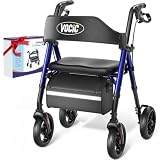


Top Picks at a Glance
Best Overall
SOUNDFUSE Walkers for Seniors
Lightweight aluminum, loop hand brakes, padded seat + back, under-seat basket, tool-free height adjust. ~$79.99.

soundfuse Foldable Rollator Walkers for Seniors with 16" Ergonomic Arc Seat | Sturdy Frame, Double Support Bar, 8" Wheels for All Terrain, Padded Seat, Dual Height Adjustable, Tool-Free Assembly


As an Amazon Associate we earn from qualifying purchases. Product prices and availability are accurate as of the date/time indicated.
Runner-Up
Drive Medical Nitro Euro Style Rollator
8″ wheels handle outdoor terrain, cross-brace fold, 300-lb capacity. Better for active outdoor use on uneven surfaces.
Search “Drive Medical Nitro Rollator” on Amazon for current pricing.
Best Budget
Medline Premium Empower Rollator
Under $60, fold-flat for car transport, padded seat, 6″ wheels. Best for primarily indoor use. Search “Medline MDS86850” on Amazon.
soundfuse Foldable Rollator Walkers for Seniors with 16" Ergonomic Arc Seat | Sturdy Frame, Double Support Bar, 8" Wheels for All Terrain, Padded Seat, Dual Height Adjustable, Tool-Free Assembly
As an Amazon Associate we earn from qualifying purchases. Product prices and availability are accurate as of the date/time indicated.
The Mobility Aid Decision Tree
Before spending money on any mobility aid, answer these questions in order. The right device is determined by your loved one’s specific functional needs — not by what they are willing to accept.
| Question | Yes | No → Next |
|---|---|---|
| Doctor/PT prescribed non-weight-bearing on one leg? | Standard walker or forearm crutches | Continue ↓ |
| Needs to sit down during walks (fatigue, angina, COPD)? | Rollator with seat | Continue ↓ |
| Has significant balance impairment (falls in last 6 months)? | Rollator (2-wheel or 4-wheel) | Continue ↓ |
| Walks outdoors on uneven surfaces regularly? | Rollator with 7–8″ wheels | Continue ↓ |
| Mild unsteadiness only, no fall history? | Quad cane or single-point cane | Cane or nothing |
If you answered “rollator” anywhere in this tree, keep reading. If PT prescribed a specific device, follow that prescription — no article should override a physical therapist’s assessment of your family member.
soundfuse Foldable Rollator Walkers for Seniors with 16" Ergonomic Arc Seat | Sturdy Frame, Double Support Bar, 8" Wheels for All Terrain, Padded Seat, Dual Height Adjustable, Tool-Free Assembly
As an Amazon Associate we earn from qualifying purchases. Product prices and availability are accurate as of the date/time indicated.
Rollator vs. Standard Walker: Side-by-Side Comparison
| Feature | Rollator (4-wheel) | Standard Walker | 2-Wheel Walker |
|---|---|---|---|
| Movement style | Roll continuously — no lifting | Lift and place each step | Glides on front wheels, lifts rear |
| Weight bearing support | Moderate (brakes required) | Maximum support | High support |
| Brake system | Loop hand brakes (essential) | None needed | None |
| Built-in seat | Yes (most models) | No | No |
| Storage/basket | Yes | Some attachments available | Some attachments available |
| Folds for transport | Yes | Yes | Yes |
| Outdoor capability | Good (6″+ wheels) | Limited | Fair |
| Cognitive demand | Higher (must remember brakes) | Lower | Medium |
| Typical price | $60–$300 | $20–$80 | $30–$100 |
Important safety note for rollators: A rollator with wheels can roll away if brakes are not engaged during sitting. Users with moderate or severe cognitive impairment may forget to lock brakes before sitting — in that case, a standard walker is the safer choice regardless of mobility level.
SOUNDFUSE Walkers for Seniors: Full Review
The SOUNDFUSE rollator (B0GLYVMX52) hits a strong balance of weight, durability, and features at the sub-$100 price point that most families are working with. Here is what matters:
| Specification | Details |
|---|---|
| ASIN | B0GLYVMX52 |
| Price | $79.99 (as of 2026) |
| Frame material | Aluminum (lightweight) |
| Weight capacity | 300 lbs |
| Product weight | Check listing — typically 14–17 lbs for aluminum rollators in this class |
| Wheel size | 6″ (indoor/smooth outdoor) |
| Brake type | Loop hand brakes with locking feature |
| Seat | Padded seat with backrest |
| Storage | Under-seat basket |
| Height adjustment | Tool-free push-button |
| Fold style | Cross-brace fold for car transport |
Pros
- Aluminum frame keeps weight manageable for seniors and caregivers lifting into car trunks
- Loop brakes are ergonomically accessible for hands with limited grip strength
- Padded seat and backrest — important for users who actually use the rest feature, not just a thin plastic perch
- Under-seat basket handles groceries, medications, or a small purse — reduces the “hands full” situation that causes falls
- Tool-free height adjustment means it can be correctly fitted without calling for help
- 300-lb capacity covers the vast majority of users
Cons
- 6″ wheels are adequate for smooth sidewalks and indoor use but struggle with gravel, grass, or cobblestone
- At this price tier, the basket zipper and seat padding may show wear within 2–3 years of daily use
- Not ideal for users with severe tremor — loop brakes require deliberate hand movement to engage
Rollator Wheel Size: Why It Matters More Than It Sounds
Wheel diameter is the single most overlooked spec when families buy rollators. Larger wheels roll over uneven surfaces, threshold bumps, and sidewalk cracks without stopping abruptly — which is exactly the type of jolt that causes a fall.
- 6″ wheels: Best for indoor use — smooth floors, hospital corridors, stores. Compact fold. The SOUNDFUSE and most budget rollators use 6″ wheels.
- 7.5″ wheels: Good all-around compromise — handles most sidewalk irregularities. Most mid-range rollators.
- 8″ wheels: Outdoor-capable. Can handle grass, gravel, minor terrain changes. Drive Medical Nitro is the most recognized option in this class.
Fitting a Rollator Correctly
Incorrect handle height is one of the main reasons seniors stop using their rollators. Too low = hunching forward, back pain. Too high = shrugging shoulders, poor stability.
Correct fit: stand upright, arms hanging naturally at sides. Handle height should be at wrist crease level — approximately the same height as the hip joint. Elbows should have a slight bend (15–20 degrees) when holding the handles. If the rollator does not have a wide enough height range for the user, it is the wrong model. See our see bathroom safety checklist aging in place for a complete mobility aid fitting guide. Also relevant: learn about ada compliant bathroom grab bars guide as the indoor complement to rollator use.
Frequently Asked Questions
Will Medicare cover a rollator walker?
Medicare Part B covers rollators as Durable Medical Equipment (DME) when a physician certifies medical necessity and you purchase from a Medicare-enrolled supplier. Coverage is typically 80% of the approved amount after the Part B deductible. You must have a diagnosis supporting the need (balance disorder, arthritis, neurological condition, etc.). A prescription alone is not sufficient — medical necessity documentation is required.
What is the difference between a rollator and a walker with wheels?
A rollator has 4 wheels, hand brakes, and almost always a built-in seat. A “2-wheel walker” has 2 front wheels and 2 rubber tips in the rear — it glides but requires lifting the back slightly. Rollators are faster and smoother for community ambulation; 2-wheel walkers provide more resistance for users who need slower, more controlled movement. Neither is “better” — the right choice depends on the individual’s strength, balance, and cognitive ability to use brakes.
Is it safe for someone with Parkinson’s to use a rollator?
Rollators are frequently recommended for Parkinson’s patients — the continuous motion can actually reduce freezing-of-gait episodes compared to standard walkers that require stop-start lifting. However, the brake requirement is a concern for users with significant tremor or cognitive impairment. U-Step walkers with reverse-brake design (brakes engage unless actively held open) are a safer alternative for Parkinson’s. Consult a neurologist or movement disorder PT.
How do you fold a rollator for a car?
Most rollators (including the SOUNDFUSE) use a cross-brace fold — lift the seat up and the frame collapses inward. The folded unit typically fits in a standard car trunk or back seat. Practice folding before the first outing. Width when folded is usually 10″–12″. Weight ranges from 13 lbs (ultralight models) to 20+ lbs — consider whether the caregiver can safely lift it into the trunk, not just the user.
At what age should a senior start using a rollator?
Age is not the deciding factor — functional need is. Rollator use is appropriate at any age following a fall history, a diagnosis affecting balance or gait (stroke, Parkinson’s, severe arthritis, neuropathy), or when a physician or physical therapist identifies fall risk. Using a rollator “before you need it” during community outings is not a sign of decline — it is a sign of fall-prevention awareness.
Related Guides
- Best Ankle Support Braces for the Elderly: Stability and Pain Relief
- Stair Lift Residential Comparison
- Best Electric Scooter For Mobility 2026
Related Reviews & Guides



Quick Picks: Best Grip Tape for Stair Handrails for the…
6 Best Second Hand Mobility Scooters For Sale 2026