Last Updated: September 26, 2026
Home blood pressure readings give doctors a far clearer picture than a single reading in the office, where nerves can push numbers up. For older adults managing hypertension or medication changes, a reliable home monitor is one of the most useful health tools in the house. The five main monitor types differ in accuracy, ease of use and fit. This comparison focuses on what matters for seniors in 2026, especially cuff size and simple controls.
Quick answer: Our top pick in 2026 is the 1. Upper-arm automatic, basic — our #1 rated choice. See the full ranked comparison, alternatives and buying advice below.
Five monitor types compared
| Type | Accuracy for most seniors | Ease of use | Typical price | Notes |
|---|---|---|---|---|
| 1. Upper-arm automatic, basic | High when cuff fits | Very easy, one button | $30 to $60 | Best starting point |
| 2. Upper-arm with memory and averaging | High | Easy | $50 to $100 | Stores readings, averages multiple |
| 3. Upper-arm connected (app) | High | Moderate, needs phone | $60 to $150 | Shares data with family or clinic |
| 4. Wrist monitor | Lower, sensitive to position | Easy | $25 to $80 | Only when arm cuffs do not fit |
| 5. Talking monitor | High (upper-arm) | Very easy for low vision | $40 to $90 | Announces readings aloud |
1. Basic upper-arm monitors
A cuff around the upper arm connected to a unit with a large display. Most major medical associations recommend upper-arm monitors as the most reliable home option. A one-button design is ideal for people who find settings confusing.
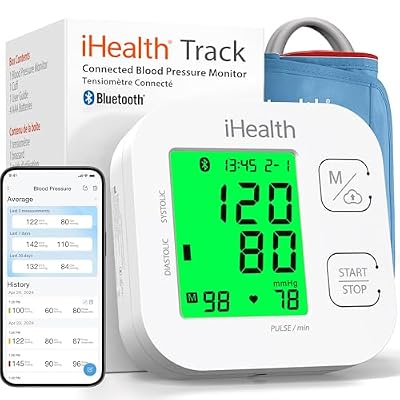
iHealth Track Smart Upper Arm Blood Pressure Monitor with Wide-Range Cuff
Included for 'Top 5 Blood Pressure Monitor Types for Seniors Compared' as a relevant option in this category; details come from the product listing.
View on Amazon
OMRON Platinum Blood Pressure Monitor & Upper Arm Blood Pressure Cuff
Included for 'Top 5 Blood Pressure Monitor Types for Seniors Compared' as a relevant option in this category; details come from the product listing.
View on Amazon
Talking Blood Pressure Monitor for Seniors and Low Vision - Hear Your Numbers Aloud - Automatic Upper Arm Cuff, Large Backlit Display, 3 User Memory, Carry Bag and Batteries Included
Included for 'Top 5 Blood Pressure Monitor Types for Seniors Compared' because the listing specifies Hear Your Numbers Aloud and Automatic Upper Arm Cuff, details this guide uses to compare options.
View on Amazon
OMRON Silver Blood Pressure Monitor & Upper Arm Blood Pressure Cuff
Included for 'Top 5 Blood Pressure Monitor Types for Seniors Compared' as a relevant option in this category; details come from the product listing.
View on Amazon2. Memory and averaging models
These store dozens or hundreds of readings, often for two users, and some automatically take two or three readings a minute apart and average them. Averaging reduces the effect of a single odd reading.
3. Connected monitors
Bluetooth or Wi-Fi monitors send readings to a phone app, which can produce charts for doctor visits or share results with a family member. They are useful for adult children helping from a distance, but only if the senior is comfortable with the setup or has help.
4. Wrist monitors
Wrist monitors are compact and easier to put on, but readings are very sensitive to wrist position relative to the heart. They are generally less reliable and best reserved for people whose upper arms are too large or painful for a cuff, with guidance from a clinician.
5. Talking monitors
These announce readings aloud, which helps people with low vision or those who find small numbers hard to read. Check that the volume is adjustable.
Getting the cuff size right
The most common cause of inaccurate home readings is the wrong cuff. A cuff that is too small produces falsely high readings; too large can read low. Measure around the middle of the upper arm and compare with the cuff range printed on the box.
| Arm circumference | Typical cuff |
|---|---|
| 7 to 9 in | Small adult |
| 9 to 13 in | Standard adult |
| 13 to 17 in | Large adult |
| Over 17 in | Extra-large or thigh cuff |
How to take accurate readings
- Sit quietly for five minutes with back supported and feet flat.
- Rest the arm on a table so the cuff is at heart level.
- Avoid caffeine, exercise and smoking for 30 minutes before.
- Take two readings a minute apart, morning and evening, as your clinician suggests.
- Do not talk during the reading.
Validation and checking accuracy
Choose a monitor that has been clinically validated. Validated device lists are maintained by medical organizations. Bring your monitor to a doctor visit and compare readings with the office device to confirm it is accurate for you.
Paying for a monitor
Original Medicare generally does not cover home blood pressure monitors except in specific situations, such as some home dialysis patients. Some Medicare Advantage plans include an over-the-counter allowance that covers them, and HSA and FSA funds can usually be used.
FAQ
Which blood pressure monitor is most accurate for seniors?
A validated upper-arm monitor with a correctly sized cuff is the most accurate home option for most people. Irregular heart rhythms can affect readings, so mention them to your doctor.
What should I do if my home readings are very high?
Follow the plan your clinician gave you. Readings far above your usual range, especially with chest pain, shortness of breath, weakness or confusion, need urgent medical attention.
Bottom line
Most seniors are best served by a validated upper-arm monitor with a properly sized cuff and simple controls. Add memory, averaging, app sharing or a voice feature if they solve a real problem, and use a wrist monitor only when an arm cuff is not an option.
Ready to decide? Our #1 pick for 2026 is the 1. Upper-arm automatic, basic.
Live price & availability on Amazon.
Related Reviews & Guides


Best Thermal Carafe Coffee Makers for Hot Coffee
Best Folding Power Wheelchair for Seniors