Last Updated: October 4, 2026
Before anything else, one fact has to be clear, because a great deal of online advice quietly skips it. In the United States, a portable oxygen concentrator is a prescription medical device. You cannot correctly choose one from a product listing the way you would choose a blood pressure cuff, and no article, including this one, can tell you which device or which setting is right for your lungs. That determination belongs to your doctor, based on testing.
What you can do, and what this guide is for, is arrive at that appointment informed. If your physician has decided that portable oxygen is appropriate, there are still real choices to make about size, battery, noise and service, and those choices affect whether you actually use the equipment or leave it in a closet. Below are the factors worth raising with your doctor and your equipment supplier, plus the real cost of the accessories you will buy yourself.
Quick answer: For most people in 2026, the best portable oxygen concentrator for active seniors is the Delivery mode — our #1 rated choice. See the full ranked comparison, alternatives and buying advice below.
Quick Verdict
For an active person, the two specifications that decide everything are how the device delivers oxygen and how long it runs away from a power outlet. Delivery mode is a clinical question: some devices deliver oxygen in pulses triggered by your breathing, others provide a continuous stream, and they are not interchangeable. Your doctor decides which type your prescription requires, and that decision narrows the field before you compare anything else.
Once your prescription is known, the practical comparison is weight you can carry, battery run time at the setting your doctor prescribed, noise, warranty, and how quickly the supplier can service the unit when something fails. A lighter device that does not meet your prescription is not a lighter device; it is the wrong device.
| What to compare | Why it matters for an active life | What to ask your doctor or supplier |
|---|---|---|
| Delivery mode | Determines whether a given portable unit can meet your prescription at all | “Does my prescription call for pulse delivery, continuous flow, or either?” |
| Battery run time at my prescribed setting | Advertised run times are quoted at low settings; yours may differ substantially | “What run time should I expect at the setting you have prescribed for me?” |
| Total carried weight | Includes the unit, the battery you actually use and the carry bag | “Can I try lifting and carrying this configuration before we finalize it?” |
| Noise level | Affects sleep, conversation, church, theaters and shared rooms | “Can I hear the unit running at my setting before I commit?” |
| FAA acceptance for flying | Airlines only permit specific devices and require battery planning | “Is this model accepted for air travel, and what paperwork do I need?” |
| Warranty and servicing | Downtime matters more than features when you rely on the device | “What happens if it fails on a Saturday, and do you provide a loaner?” |
| Backup plan | Power outages and device failures happen | “What backup oxygen supply should I keep at home?” |
| Cost and coverage | Coverage depends on documentation and supplier, not on the product itself | “Is this supplier in network, and is this rented or purchased?” |
How to Choose
Your prescription comes first and narrows the field
Oxygen is a drug in regulatory terms, and it is prescribed with specific parameters after testing. Never set, change or estimate a setting yourself, and never accept a recommendation from a salesperson, a friend or a website about what your setting should be. If you feel that your current arrangement is not working for you, that is a reason to call your doctor, not a reason to adjust a dial.
It follows that the first question to any supplier is whether a given device can deliver what your prescription requires, in the situations you actually need it, including at rest, walking and sleeping. Some people need different arrangements for different activities, and that is a clinical conversation rather than a purchasing one.
Weight is what you carry, not what the box says
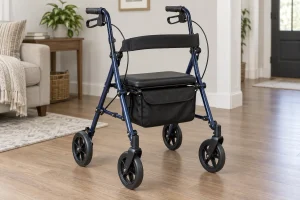
Listed weights usually describe the unit with its smallest battery. Active use means the larger battery, a carry bag, a spare battery and perhaps a charger, and that combination can weigh substantially more than the headline figure. Ask to hold the full configuration before deciding. If you also use a walker or rollator, check how the bag sits when it is attached to the frame, since a bag that swings into your legs is a fall risk.
Battery claims are quoted under favorable conditions
Run time figures in marketing material are usually measured at the lowest setting, with a new battery, at room temperature. Your real-world run time depends on your prescribed setting, your breathing rate, the age of the battery and the weather. Ask the supplier what run time you should expect under your own prescription, plan for less than the number you are told, and always leave home with more battery than the outing seems to require.
Noise decides whether you take it places
People underestimate this until they are in a quiet room. A unit that is inaudible in a store can be intrusive in a theater, at a dinner table or beside a bed. If you sleep with the device running, ask to hear it in a quiet room before accepting it. Devices vary meaningfully, and this is one specification that directly determines whether equipment gets used or avoided.
Flying takes planning, not just a device
Airlines only accept specific portable oxygen concentrator models, and they generally require you to bring enough battery capacity to cover the full duration of the flight plus a substantial margin for delays. Many carriers also require paperwork from your doctor, submitted in advance. Call the airline’s accessibility desk well before the trip, ask exactly what they require, and ask your supplier to confirm the model is accepted. Do not rely on a forum post or an old article, since airline policies change.
Service matters more than features
When you depend on a device daily, the question is not what it does when working but what happens when it stops. Ask who to call after hours, how long a repair typically takes, whether a loaner unit is provided, what the warranty covers and for how long, and whether batteries are covered separately. A supplier with responsive local service is worth more than a marginally lighter unit.
Coverage depends on documentation and supplier, not on the product
No oxygen device is automatically covered by insurance simply because it is medical equipment, and any advertisement implying otherwise should be treated with caution. What determines coverage is your doctor documenting medical necessity according to your plan’s criteria, the testing that supports it, and obtaining equipment from a supplier that participates in your plan. Home oxygen is often supplied on a rental basis rather than purchased outright, which changes what you own at the end. Ask your plan directly what it requires, and for Medicare specifically, verify current rules at medicare.gov.
The Picks in Detail
The device itself comes from your supplier. Portable concentrators are dispensed through durable medical equipment providers against a prescription, which is why the familiar consumer marketplaces largely sell accessories rather than units. Names you will encounter in the supplier’s catalog include Inogen, Rhythm Healthcare, CAIRE and OxyGo. Compare the ones your supplier offers against the factors in the table above with your prescription in hand, rather than choosing a brand first.
Batteries are the accessory that changes your day. A second battery is the difference between a two-hour errand and a full day out. Manufacturer batteries are model-specific and priced accordingly: an Inogen extended 16-cell battery for the One G5 and Rove 6 runs about $350, an extended 8-cell battery for the G4 and Rove 4 about $375, and a standard 8-cell battery for the older One G3 about $150. A Rhythm Healthcare P2 battery runs about $200, with a bundle including an external charger and AC power supply at about $500. Confirm the exact part number for your unit before ordering, since batteries are not interchangeable between models.
Carry bags and backpacks distribute the weight better than a shoulder strap. A backpack keeps your hands free and your balance more even, which matters if you also use a cane or rollator. Model-specific options include CURMIO backpacks for Inogen, OxyGo and CAIRE units at about $50, CURMIO travel bags for the same families at about $40 to under $40, and O2TOTES backpacks for Inogen One G5 and Rove 6 or for Rhythm P2 units at about $55. Buy to fit your specific model, and check that the ventilation openings on the bag line up with the intake on the unit, because blocking them can cause the device to overheat.
Cannulas and tubing are consumables, not permanent parts. Replacement nasal cannulas with long tubing are inexpensive and should be replaced on the schedule your supplier or doctor recommends rather than when they look worn. A ResOne 25-foot cannula runs about $5 singly or about $20 for a five-pack, and a Westmed five-pack with 25-foot kink-resistant tubing about $25. Long tubing is useful indoors so you can move around a room without carrying the unit, but it also creates a trip hazard, so plan the route it takes across the floor.
A pulse oximeter is a monitoring tool, not a control dial. Fingertip oximeters such as the Zacurate 500BL at about $10, the Zacurate 500 series at about $20 or the Innovo Deluxe at about $30 are inexpensive and many doctors ask patients to record readings. Understand clearly what they are for: they give your care team information. They are not a basis for changing your oxygen setting yourself, and readings can be affected by cold hands, nail polish, movement and poor circulation. Ask your doctor what readings they want recorded, how often, and at what point you should call.
Related guides: best lightweight oxygen concentrator for travel, portable oxygen concentrator battery life compared, portable oxygen concentrator vs oxygen tank, best lightweight rollator for travel, rollator vs standard walker which to choose
FAQ
Can I buy a portable oxygen concentrator without a prescription?
In the United States these are prescription devices. Sellers offering them without one should be treated as a warning sign about the product and the seller alike. Beyond the legal question, the delivery mode and settings have to match what your research shows you need, and that requires a clinician.
How long do the batteries really last?
Less than the advertised figure in most real situations, because those figures are measured at the lowest setting under ideal conditions. Ask your supplier what to expect at your prescribed setting, and carry a spare. Batteries also lose capacity over a few years of charge cycles, so a device that used to last a full outing may not after a couple of years.
Can I take one on a plane?
Often yes, if the model is accepted by that airline and you meet their battery and documentation requirements. Call the airline’s accessibility desk well before travel, confirm the model, and ask exactly how much battery capacity they require for your itinerary including possible delays.
Will Medicare cover it?
Home oxygen equipment can be covered when specific clinical criteria are documented and the equipment is obtained through a participating supplier, frequently as a rental arrangement. Coverage is never automatic and never a property of the product itself. Confirm the current requirements at medicare.gov or with your plan before making any commitment.
What should I do if I feel short of breath even while using my oxygen?
Contact your doctor, and seek emergency care if symptoms are severe or sudden. Do not adjust your own settings, and do not use someone else’s equipment. A change in how you feel on oxygen is medical information your care team needs promptly.
Ready to decide? Our #1 pick for 2026 is the Delivery mode.
Live price & availability on Amazon.
Related Reviews & Guides



6 Best Sockwell Compression Socks For Nurses 2026

6 Best Shower Chairs For The Bathtub 2026