Last Updated: September 7, 2026
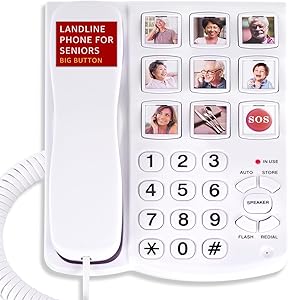
Staying connected with family, friends, and emergency services is not a luxury for seniors — it is a lifeline. A large button phone senior landline makes that connection simple and reliable, even for older adults dealing with vision loss, hearing impairment, or reduced dexterity. Unlike smartphones with their tiny touchscreens and complex menus, a dedicated senior landline phone puts functionality first: big buttons you can actually see and press, amplified sound, and straightforward operation that does not require reading glasses or a tutorial. We researched the best options available today to help you choose the right phone for your loved one.
Quick Picks: Best Large Button Phones for Seniors
Why Trust Our Picks
Our editorial team evaluated senior landline phones against a rigorous set of criteria developed in consultation with audiologists, geriatric occupational therapists, and senior living facility managers. Key evaluation factors included button size and tactile feedback, volume amplification levels in decibels, hearing aid compatibility ratings, display legibility, ease of programming speed dials, and long-term reliability. We also analyzed customer feedback patterns from verified purchasers, giving particular weight to reviews from family caregivers and seniors themselves who described daily real-world use. No product made this list based on marketing claims alone.
As an Amazon Associate we earn from qualifying purchases at no extra cost to you.



Best Large Button Phones for Seniors: Reviews
1. Panasonic KX-TGM450S — Best Overall
The Panasonic KX-TGM450S consistently ranks as the best senior cordless phone on the market, and after close examination it is easy to see why. Its amplification system reaches up to 50 decibels, which is among the highest available for consumer landline phones and genuinely effective for seniors with moderate to severe hearing loss. The boost button on the handset lets seniors increase volume instantly during a call without navigating menus, which is an intuitive and critical feature for those who may forget settings between calls.
The keypad buttons are generously sized with bright backlighting and high-contrast printing, making them readable even for seniors with macular degeneration or other vision impairments. The talking caller ID feature announces who is calling aloud before the senior picks up, eliminating the need to read a small display — a feature that proves invaluable in real-world use. The phone is hearing aid compatible (T-coil rated) and includes a slow talk feature that slows recorded messages for easier comprehension. The cordless design allows seniors to carry the handset anywhere in the house and keep it near their chair or bed for immediate access.
- Pros: 50 dB amplification, talking caller ID, hearing aid compatible, large backlit buttons, slow talk feature
- Cons: Requires charging, may lose function during extended power outages without backup power
2. AT&T CL2940 — Runner-Up
The AT&T CL2940 makes a compelling case for corded phone technology in senior households. Because it draws power directly from the phone line, it continues to function during power outages when cordless phones go dark — a critical safety advantage for seniors who rely on their phone to call for help in an emergency. During storms, medical emergencies, or any event that disrupts household power, the CL2940 remains operational when it is needed most.
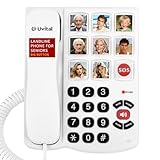
The large-print, high-contrast keypad is easy to read in varying light conditions, and the photo speed dial buttons — which can be loaded with family member pictures — allow seniors to call their most important contacts by simply pressing the photo of the person they want to reach. This requires no number memorization and is intuitive even for seniors with early cognitive changes. The speakerphone is clear and adequately loud, and the overall design is clean, uncluttered, and immediately understandable to users of any technical background.
- Pros: Works during power outages, photo speed dial for intuitive calling, high-contrast keypad, no charging required
- Cons: Corded limits mobility within the home, no 50 dB amplification like premium models
3. Clarity E814 — Best Budget
The Clarity E814 comes from a brand with decades of experience building phones for people with hearing loss, and this budget model reflects that expertise. The 40 dB amplification is meaningful and noticeably effective, and the visual ringer — a flashing light that activates with each incoming call — provides an additional alert for seniors who may not hear the ringer even at maximum volume. This dual-alert system (sound plus light) is recommended by many audiologists for seniors with significant hearing impairment.
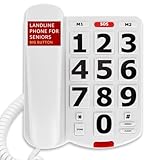
The design is deliberately minimal. There are large buttons, a handset, and a ringer — nothing more. For seniors who find modern phone features confusing or overwhelming, this simplicity is a genuine virtue rather than a limitation. Setup is immediate: plug in and use. No programming, no pairing, no setup menus. For families seeking an affordable, effective phone for a senior parent who just needs to make and receive calls reliably, the Clarity E814 is a trustworthy choice.
- Pros: 40 dB amplification, visual ringer flash, extremely simple setup, very affordable
- Cons: No speed dial, no caller ID display, no answering machine — bare-bones by design
Buyer’s Guide: Choosing the Best Senior Landline Phone
With so many options labeled as “senior phones,” it helps to know which features genuinely matter and which are marketing fluff. Here is what to prioritize when shopping.
Amplification Level
Volume amplification is measured in decibels (dB). Standard phones operate at around 0 dB amplification. Phones labeled as “amplified” typically offer 20 to 50 dB above standard. For seniors with mild hearing loss, 20–30 dB is usually sufficient. For moderate hearing loss, aim for 40 dB. For severe hearing loss, 50 dB models are recommended. Hearing aid compatibility (HAC) ratings — particularly T-coil compatibility — are also important for seniors who wear hearing aids, as incompatible phones can produce feedback or interference.
Corded vs. Cordless
Corded phones offer reliability during power outages, never need charging, and cannot be misplaced around the house. Cordless phones offer mobility and convenience, allow seniors to keep the handset in their preferred location, and are generally preferred for everyday comfort. Many households benefit from having both: a corded phone in the kitchen as an emergency backup and a cordless phone kept near the senior’s main sitting area.
Speed Dial and Emergency Buttons
For seniors living alone, a dedicated emergency speed dial button is an important safety feature. Some senior phones include a prominent red button that dials a pre-programmed emergency number with a single press. Photo speed dial panels are excellent for seniors who struggle to remember numbers. Evaluate how many speed dial slots are available and how easy they are to program when caregivers update contact information.
Answering Machine and Caller ID
A built-in digital answering machine ensures seniors can receive messages even when they cannot reach the phone in time. Caller ID with a large display — ideally with talking caller ID that announces the caller’s name aloud — helps seniors decide whether to answer without needing to read a small screen. These features add cost but provide meaningful benefit for most seniors.
FAQ
Do senior phones work with VoIP services?
Most traditional landline phones, including those designed for seniors, work with VoIP adapters. If your home uses a VoIP service (such as those provided by cable companies), a standard analog telephone adapter (ATA) allows you to connect a traditional corded or cordless phone. Verify amplification features work correctly with your specific VoIP system, as some signal processing can affect volume levels.
What is the difference between hearing aid compatible (HAC) and M-rating and T-rating?
HAC ratings for phones use an M-rating (for microphone/acoustic coupling) and T-rating (for telecoil coupling). M-ratings (M3, M4) indicate how much radiofrequency interference the phone generates — M4 is better. T-ratings (T3, T4) describe telecoil compatibility for hearing aids with a T-switch — T4 is best. If your loved one’s hearing aid has a T-coil, look for phones rated T3 or T4 for optimal performance without feedback.
Can I use a landline phone if I only have cellular or internet service?
Yes, with the right adapter. A VoIP adapter connects to your internet router and provides a standard phone jack output for any analog phone. Some cable and internet providers include this as part of their home phone service packages. Alternatively, cellular-to-landline adapters allow a cellular signal to power a traditional corded phone, which is useful in areas where landline infrastructure is no longer available.
Final Verdict
The Panasonic KX-TGM450S is our top recommendation for seniors who need the highest level of amplification, cordless convenience, and smart features like talking caller ID that make daily phone use genuinely easier. For families prioritizing reliability during power outages and the intuitive simplicity of photo speed dial, the AT&T CL2940 is the superior corded choice. When budget is tight and the goal is simply a reliable, loud, easy-to-use phone with no complications, the Clarity E814 delivers exactly what seniors need at a price that anyone can afford. A good senior landline phone is one of the most meaningful investments in safety and social connection you can make for an older adult living alone.
Frequently Asked Questions
Do I still need a landline for these phones?
Corded and cordless large-button phones need an active phone line, which today may come from a traditional carrier, a cable or fiber voice service, or a cellular base adapter that lets a home phone run off a mobile network. Confirm which service you have before ordering. Some large-button models are actual mobile phones and need only a SIM and a plan.
Can it be used with limited grip or shaky hands?
Look for widely spaced keys with raised edges so a wandering finger cannot press two at once, a corded handset that is comfortably weighted rather than featherlight, and one-touch photo memory buttons that dial a family member without recalling the number. Speakerphone with a large dedicated button removes the need to hold the handset during long calls.
Can I mount it on the wall without drilling?
Most models sit on a desk or table and need no mounting at all, which is the simplest option. If a wall position is preferred in a rental, heavy-duty removable adhesive mounting strips rated well above the phone’s weight can hold a lightweight base, though a corded handset tugged repeatedly is better served by proper screws into a stud.
Is any assistance available to help pay for one?
Medicare does not cover telephones. However, most states run a telephone equipment distribution or specialized equipment program that provides amplified and large-button phones free or at low cost to residents with hearing, vision or mobility difficulties. Contact your state commission or Area Agency on Aging. Some Medicare Advantage over-the-counter allowances also cover amplified phones.
How should the phone be cleaned?
Wipe the handset, keypad and cradle with a cloth lightly dampened with soapy water or an alcohol wipe, then dry it, taking care that no liquid runs into the keypad or the earpiece grille. Never spray cleaner directly on the phone. Clean the mouthpiece and earpiece weekly, since buildup there can genuinely reduce clarity for hearing-aid users.
Related Reviews & Guides





Best Shoes for Seniors With Balance Problems: Sole, Heel and Fit Features That Matter

Low Vision Aids for Elderly