Last Updated: September 27, 2026
A rollator with a seat and a transport wheelchair both have four wheels, fold for the car trunk, and show up on the same store pages, so it is easy to assume they do the same job. They do not. A rollator is a walking aid: you push it, walk behind it, and sit on it only to rest. A transport wheelchair is a seating aid: someone else pushes you. Picking the wrong one either takes away walking that could have been preserved, or leaves a tired person stranded halfway through an outing. This comparison helps you match the device to real stamina and balance.
Quick answer: Our top pick in 2026 is the Who moves it — our #1 rated choice. See the full ranked comparison, alternatives and buying advice below.
What Each Device Is For
Rollator with seat
A rollator has three or four wheels, hand brakes, a padded seat and usually a basket. The user walks with it for support and balance, then locks the brakes and sits down when tired. It encourages walking, which helps maintain leg strength and endurance. It is not designed to be pushed with someone sitting on it, and doing so can cause tipping or frame damage.

Drive Medical Rollator Walker with Seat, 7.5 Inch Wheels, Blue
Included for 'Rollator with Seat vs Transport Wheelchair Which Is Better for Seniors' because the listing specifies 7.5 Inch Wheels and Blue, details this guide uses to compare options.
View on Amazon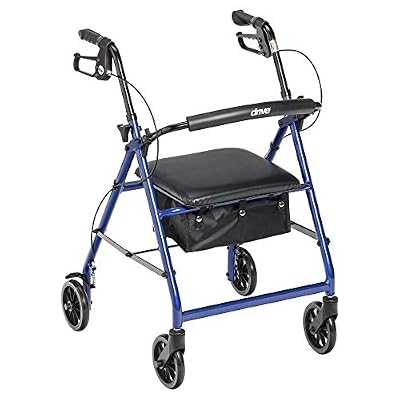
Drive Medical Aluminum Rollator Walker, Padded Seat, 6-Inch Wheels, Blue
Included for 'Rollator with Seat vs Transport Wheelchair Which Is Better for Seniors' because the listing specifies Padded Seat and 6-Inch Wheels, details this guide uses to compare options.
View on Amazon
Drive Medical Nitro Sprint Rollator Walker with Seat, Standard Size, Red
Included for 'Rollator with Seat vs Transport Wheelchair Which Is Better for Seniors' because the listing specifies Standard Size and Red, details this guide uses to compare options.
View on Amazon
Drive Medical R728BL Foldable Rollator Walker with Seat, Blue
Included for 'Rollator with Seat vs Transport Wheelchair Which Is Better for Seniors' because the listing specifies Blue, details this guide uses to compare options.
View on AmazonTransport wheelchair
A transport chair has four small wheels, typically 8 to 12 inches, and push handles for a companion. Unlike a standard wheelchair, the rear wheels are too small for the rider to propel themselves. It is lighter, often 15 to 25 pounds, and folds compactly for car trips and appointments.
Side-by-Side Comparison
| Factor | Rollator with seat | Transport wheelchair |
|---|---|---|
| Who moves it | The user, walking | A caregiver pushing |
| Typical weight | 13–20 lb | 15–25 lb |
| Weight capacity | 250–300 lb standard; bariatric 400–500 lb | 250–300 lb standard |
| Price range | $70–$250 | $120–$350 |
| Sitting while moving | Not safe | Designed for it |
| Keeps walking muscles active | Yes | No |
Matching the Device to the Person
The rollator suits people who
can walk at least short stretches with steady support, need a place to rest every few minutes, and have enough hand strength to squeeze loop brakes. It is a common choice after a period of deconditioning, with arthritis, or with mild balance problems. Walking with a rollator at the mall or park can keep someone active far longer than they could manage unaided.
The transport chair suits people who
tire after only a few dozen steps, have significant fall risk, are recovering from surgery with weight-bearing limits, or become breathless quickly. It is especially handy for long corridors in hospitals, airports and museums, and for outings where the goal is participation rather than exercise.
Many families use both
A common pattern is a rollator for daily walks around the house and neighborhood, and a transport chair folded in the car for longer destinations. The rollator preserves function; the transport chair preserves the ability to go places.
Features to Compare
Rollators
Seat height should let the user sit with feet flat and knees about level with hips; for most people that is 19 to 23 inches. Handle height should match the wrist crease with arms hanging relaxed. Larger wheels, 8 inches or more, roll better over sidewalk cracks and grass. Check that brakes are easy to squeeze with arthritic hands and lock firmly for sitting.
Transport chairs
Look for companion hand brakes on the push handles, swing-away footrests for easier transfers, a seat belt, and a seat width that fits, usually 17 to 19 inches. Rear wheels of 12 inches handle curbs and thresholds better than 8-inch ones.
Safety Tips
Never let someone sit on a rollator while another person pushes it. Always lock rollator brakes before sitting, and back up until the seat touches the legs. With a transport chair, go down curbs backwards, tilt slightly back over thresholds, and apply brakes during transfers. Both should be checked every few months for loose bolts, worn brake pads and wheel wobble.
Considering Insurance and Hybrids
Medicare Part B may cover a rollator or wheelchair as durable medical equipment when a doctor documents medical need, and the supplier accepts assignment. Some manufacturers sell hybrid rollator-transport chairs with a flip seat and footrests. They can be useful for light occasional use, but most are compromises: heavier than a rollator and less comfortable than a transport chair. Try one in person before choosing it as the only device.
FAQ
Can a rollator replace a wheelchair?
Only for people who can walk safely with support and need occasional rests. If the person cannot walk the distance required, or sits for most of the trip, a transport chair or wheelchair is the safer choice.
Is a transport wheelchair easier to lift than a regular wheelchair?
Usually yes. Transport chairs often weigh 15 to 25 pounds, while standard self-propelled wheelchairs commonly weigh 35 pounds or more, which makes transport chairs easier to load into a car.
Bottom Line
Choose a rollator with a seat if the goal is to keep walking with support and rest breaks. Choose a transport wheelchair if the person cannot cover the distance and a companion will push. For many seniors, owning both, with a physical therapist’s input on fit, gives the best balance of independence and safety.
Ready to decide? Our #1 pick for 2026 is the Who moves it.
Live price & availability on Amazon.
Related Reviews & Guides



Best Under Desk Elliptical for Seniors 2026

Best Waterproof Hearing Aids for Seniors